
GM Bets Big on the V8 Future
A Renewed Roar for American V8 Power
A Renewed Roar for American V8 Power
Electric vehicles still dominate the conversation, but on the factory floor the story is more nuanced. In April 2026, General Motors confirmed a fresh investment of more than $150 million in its Saginaw Metal Casting Operations in Michigan, a move tied directly to the company’s sixth-generation small-block V8. For anyone who assumed the great American V8 was being quietly escorted toward retirement, the message could hardly be clearer. It is not going away yet.
That matters for more than sentimental reasons. The V8 remains deeply relevant in the parts of the market where towing, payload, range, durability, and effortless low-end torque still matter more than fashion. Full-size pickups continue to form the backbone of Detroit’s business, and GM is making a very public statement that it still sees eight-cylinder power as a serious part of its long-term plan. This is not a retro gesture for enthusiasts alone. It is an industrial decision backed by real demand, real money, and real customers.
Saginaw’s Role in the Next Chapter
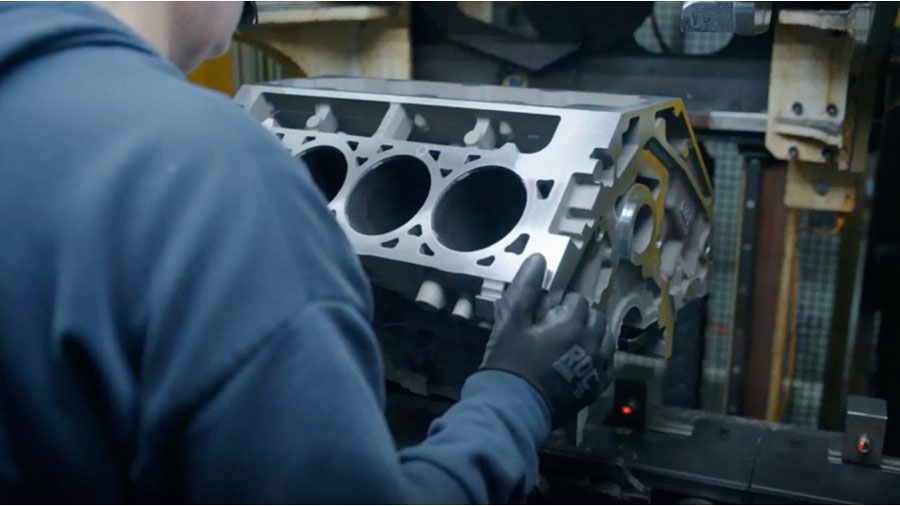
The Saginaw Metal Casting Operations site is one of GM’s oldest facilities in the United States, and that history gives the latest investment a certain symbolic weight. Yet this is not a story about preserving old bricks for the sake of heritage. The funding is intended to modernize the plant with new equipment and advanced tooling so it can cast engine blocks and cylinder heads for the next generation of V8-powered trucks. In practical terms, Saginaw is being prepared for a far more demanding role in GM’s future manufacturing network.
The plant will continue supplying components for today’s fifth-generation V8 engines while also gearing up for the sixth-generation family, which is expected to begin production in 2027. That dual responsibility makes Saginaw an important link between the present and the near future. It also underlines the fact that GM is not abruptly replacing one era with another. Instead, it is managing a deliberate transition, keeping current products supported while preparing the next wave of combustion engines for an increasingly demanding market.
There is also a human side to the announcement. The investment helps secure more than 300 jobs across three shifts, reinforcing the plant’s importance not only to GM but also to the wider regional economy in Michigan. In an industry often defined by uncertainty, automation, and shifting product priorities, commitments like this still carry weight in communities built around manufacturing.
A Bigger Bet Than It First Appears
Look only at the Saginaw figure and the announcement may seem modest by modern automotive standards. Yet that number becomes much more significant when placed in context. It is only the latest installment in a much broader commitment to the new V8 architecture.
Back in 2023, GM announced a $918 million investment across four U.S. plants to support the future of its V8 engine program. Of that total, $579 million was directed to Flint Engine Operations, where final assembly of the new small-block family will take place. The rest supported surrounding facilities responsible for key components such as cylinder block castings, connecting rods, intake manifolds, camshafts, and fuel rails. In other words, GM was not simply updating one engine plant. It was reinforcing an entire manufacturing ecosystem.
Then, in 2025, came another major announcement. GM committed $888 million to Tonawanda Propulsion near Buffalo, New York, the largest single investment the company has ever made in an engine plant. Tonawanda will become the second propulsion facility to produce the new-generation V8, adding both capacity and redundancy to the program. When Saginaw is added to Flint and Tonawanda, the overall picture becomes much harder to dismiss. GM is not keeping the V8 alive out of habit. It is spending at a level that suggests genuine long-term confidence.
What We Know About the Gen 6 Small-Block
GM has been selective with details, which is why it is important to separate confirmed facts from industry speculation. The company has said the sixth-generation small-block V8 is being engineered to deliver stronger performance while also improving fuel economy and reducing emissions. It has pointed to improvements in combustion and thermal management as part of that effort. What GM has not done, at least not yet for its truck applications, is publish a full menu of displacement options, horsepower figures, or torque outputs for future Silverado and Sierra models.
Still, one important clue has already emerged. In March 2026, Chevrolet revealed the first public application of the Gen 6 architecture in the form of a new 6.7-liter LS6 V8 for the 2027 Corvette. That engine produces 535 horsepower and 520 lb-ft of torque, while combining port and direct fuel injection with a high 13.0:1 compression ratio. It is, naturally, a sports-car interpretation of the platform rather than a truck tune. Even so, it tells us something useful. The new architecture is not merely a cleaner version of the old idea. It has been designed to move the game on.
For truck buyers, that likely means a different emphasis. Rather than chasing top-end theatrics, the pickup versions of the Gen 6 small-block will almost certainly focus on usable torque, smooth delivery under load, better thermal efficiency, and emissions compliance without sacrificing the traditional character that owners expect. That is the balancing act. Preserve the appeal, reduce the compromises, and make the engine fit for the next decade instead of the last one.
Why the V8 Still Makes Sense
The answer becomes obvious the moment you step outside the EV debate and look at how trucks are actually used. In the real world, many full-size pickup owners tow trailers across long distances, haul equipment, or spend full days on the road where convenience matters as much as technology. Fast refueling remains a serious advantage. Consistent towing performance remains a serious advantage. Long-established maintenance knowledge and proven durability remain serious advantages too.
That does not mean electric trucks have no place. They do, and GM continues to invest heavily in electric products. But the broader market has evolved more slowly than earlier forecasts suggested, especially in the heavy-duty and full-size pickup segments. Buyers have shown that they are still willing to adopt new technology, just not always at the pace imagined in boardroom presentations a few years ago. For many of them, the ideal answer today is not the total replacement of combustion but the improvement of it.
That is what makes GM’s strategy feel pragmatic rather than nostalgic. The company is not pretending the future belongs only to V8s. Nor is it acting as though battery power has failed. Instead, it is acknowledging that different types of vehicles still require different types of solutions. In that context, a modernized small-block V8 is not an act of denial. It is an example of industrial realism.
The Cultural Weight of the Small-Block
There is, of course, a more emotional dimension to all of this. The GM small-block is not just another engine family. It is one of the defining mechanical signatures of American motoring. It has powered sports cars, pickups, muscle cars, and everyday workhorses for generations. It has been tuned for racetracks, drag strips, highways, and farms. Few engine designs have been asked to do so much, for so long, in so many different roles.
That heritage helps explain why the latest investment resonates beyond business headlines. Enthusiasts hear it as proof that the soundtrack of American performance is not about to disappear. Truck owners hear it as reassurance that the machines they trust are still being developed with them in mind. Workers in places like Saginaw, Flint, and Tonawanda hear it as evidence that traditional powertrain manufacturing still has a future.
At the same time, heritage alone would never justify billion-dollar commitments. The only reason this story matters is because the small-block continues to prove adaptable. GM believes it can evolve to meet tougher efficiency and emissions targets while preserving the qualities that made it successful in the first place. If the company is right, the V8 does not need to survive as a museum piece. It can remain a working part of modern life.
More Than Nostalgia
In the end, the Saginaw investment says something larger about today’s auto industry. The future is not arriving in a single, tidy form. It is arriving in layers. Some markets are ready for rapid electrification. Others are not. Some customers want silence and software. Others still want torque, range, and the familiar confidence of proven combustion hardware. The manufacturers most likely to succeed are the ones that understand this complexity instead of fighting it.
GM’s renewed commitment to the small-block V8 suggests that the company sees value in serving the market as it exists, not as trend forecasts once imagined it would be. For the moment, that means keeping the V8 not only alive, but relevant. And for anyone who still believes there is something uniquely satisfying about a well-engineered American eight-cylinder engine doing exactly what it was built to do, that is a very welcome sound indeed.