
Engines and Escapements: Where Passions Intersect
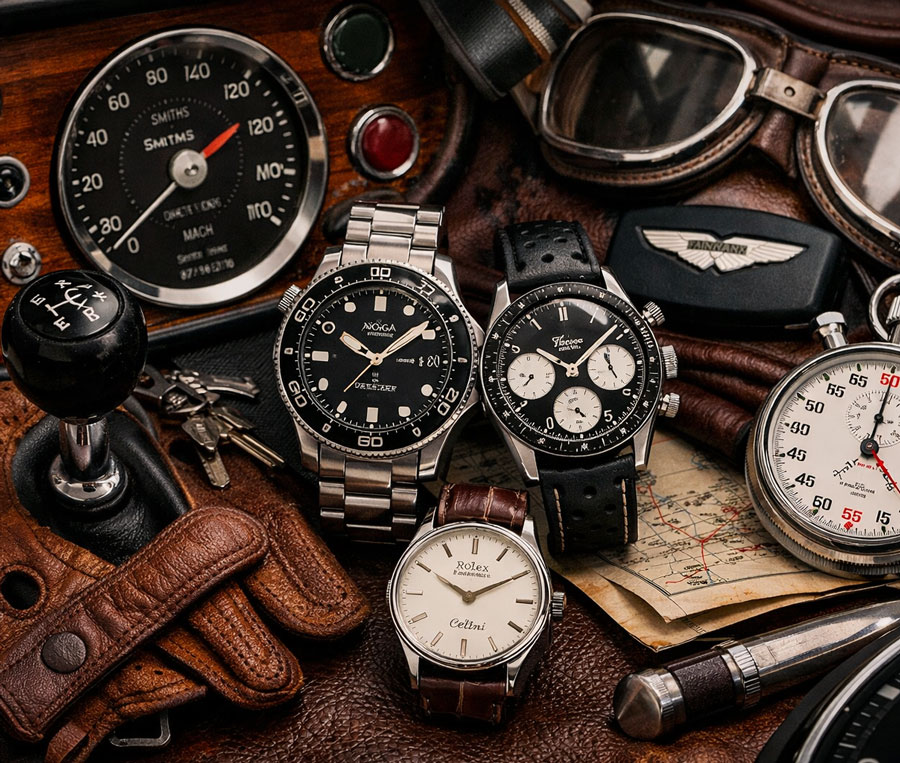
cars and watches at Life in Classic
Passion at the Crossroads of Cars and Watches
Car enthusiasts and watch aficionados often find common ground. Both communities value design, precision, and personal expression. Both also revere mechanical beauty that works as well as it looks.
Automakers and watchmakers recognize that bond. Partnerships, such as Aston Martin with Breitling, celebrate shared engineering values and brand heritage. As a result, a timepiece can echo a grand tourer’s spirit, while a dashboard can borrow the clean logic of a dial.
Beyond style, the parallels run deep. Cars and watches both rely on careful tolerances, exact timing, and dependable power delivery. They reward maintenance and respect. Moreover, they transform movement into measurable performance, whether on a road or on a wrist.
That is why the same mind that enjoys a crisp downshift often loves a smooth sweep of a seconds hand. The thrill springs from the same place: mechanical harmony in motion.
Automatic or Manual: Two Ways to Drive Time
In both garages and watch boxes, “automatic” means the machine helps you. An automatic transmission shifts for you, while an automatic watch winds itself as you move. Therefore, your daily routine keeps the mainspring energized without a second thought.
Manual machines invite more touch. A stick-shift rewards rhythm and skill. Likewise, a hand-wound watch asks for a brief ritual each day. Many collectors cherish that moment. The Rolex Cellini Cestello, reference 5330, shows how refined a manual piece can feel.
The appeal differs, yet the satisfaction aligns. Some days you want effort-free flow. Other days you prefer direct control. Either way, both paths lead to the same goal: smooth, reliable motion that reflects your mood and style.
Gears, Oil, and the Art of Service
Engines and mechanical movements share a backbone: gears. These precise teeth translate force into calibrated rotation. Without them, neither pistons nor hands would deliver dependable timing. Because gears mesh, everything else works.
Lubrication then keeps the dance quiet and efficient. Oil reduces friction, curbs wear, and preserves accuracy. In a watch, microscopic films of specialized lubricants make astonishing differences. In a car, fresh oil sustains performance and life.
Regular service sustains both machines. You change fluids, filters, and belts to keep a car healthy. Similarly, brands like Omega outline full watch services that include disassembly, ultrasonic cleaning, replacement of worn parts, and careful reassembly with fresh lubricants. Although a watch is small, its overhaul rivals major automotive work in precision.
Preventive care pays off. With it, tolerances stay tight, and timing remains true. Without it, friction wins, accuracy drifts, and costs rise.
Gaskets, Springs, and Rotors: Small Parts, Big Jobs
Tiny seals do big work. Gaskets keep lubricants in and grit, dust, and moisture out. On dive watches, seals also protect during high-pressure descents.
The Omega Seamaster 300M, the model worn by James Bond in the 1997 film Tomorrow Never Dies, makes that point easy to understand. A watch like that depends on case integrity just as much as a car depends on seals throughout its engine, gearbox, and cooling system. Tiny gaskets do the hidden work. They keep water, dust, and pressure from reaching sensitive parts, and their success is measured by the fact that you never have to think about them at all.
Springs matter just as much. In a car, springs help manage weight transfer, composure, and control. In a watch, the balance spring serves a different purpose but with equal importance. It regulates the oscillations of the balance and helps divide time into consistent beats. That tiny spiral is not dramatic to look at, yet it sits at the very heart of accuracy. The comparison feels natural. Both machines rely on small, disciplined components to govern larger movements with grace.
Then comes the rotor, one of watchmaking’s neatest solutions. In an automatic watch, the motion of the wearer’s wrist turns a weighted rotor, which winds the mainspring and keeps the movement energized. It is a beautifully efficient idea, and one that any car lover can appreciate. Good engineering often means recovering motion and turning it into something useful. In both worlds, elegance lies in making complex work feel effortless.
Dials and Dashboards: Clarity with Character
A fine dashboard and a fine watch dial solve the same problem. Both must present information quickly, clearly, and attractively. You should be able to understand them at a glance, whether you are checking oil temperature at speed or reading the time before a meeting. That need for clarity shapes everything from typography to contrast to the size and placement of markers.
Yet function alone never explains the attachment people feel. An Alfa Romeo instrument binnacle, a Smiths gauge set in a British sports car, or a well-proportioned watch dial all carry emotion as well as information. Their fonts, textures, and proportions help define a brand’s character. Some designs feel technical and austere. Others feel warm, elegant, or slightly eccentric. In both cars and watches, the display becomes part of the experience rather than a neutral tool.
That is also why analog design continues to hold such appeal. A mechanical watch does not merely tell you the time. It shows time passing. A classic dashboard does not merely report speed. It frames motion in a way that feels tangible. Needles, numerals, and scales turn invisible processes into things you can read and enjoy.
Chronographs and Tachymeters: Speed You Can Wear
If one watch complication belongs naturally in a motoring conversation, it is the chronograph. A chronograph turns a wristwatch into a stopwatch, which already brings it close to the world of laps, stages, and split times. Add a tachymeter scale, and the automotive connection becomes even clearer. Used over a fixed distance, a tachymeter lets the wearer calculate average speed from elapsed time. That is not just decorative motorsport language. It is a direct bridge between timekeeping and velocity.
No wonder racing-inspired watches remain so popular. They speak the language of performance in a way car enthusiasts instantly understand. Pushers feel like controls. Subdials resemble instruments. Bezels suggest purpose. Even when most owners never use a tachymeter in daily life, they appreciate what it represents. It captures an age when measurement, competition, and style all seemed to move together.
Materials, Finish, and Feel
Cars and watches also reveal how much passion lives in materials. Steel, aluminum, titanium, leather, sapphire, wood, and rubber all shape the user’s experience long before performance figures enter the discussion. A brushed case feels different from a polished one, just as a thin-rim wood steering wheel feels different from a thick leather-wrapped modern wheel. Texture matters. Weight matters. Temperature matters. These are tactile objects, and their appeal depends partly on how they meet the hand.
That tactile side explains why ownership becomes personal so quickly. Two people may admire the same car or the same watch for entirely different reasons. One may care about technical pedigree. Another may care about elegance, heritage, or the memory attached to a particular design. In either case, the machine becomes a companion rather than a commodity.
Why the Bond Endures
The relationship between cars and watches lasts because the two worlds reward the same kind of attention. They ask us to appreciate function, but also beauty. They invite use, not just display. Most of all, they remind us that engineering can be emotional. A fine movement and a fine engine both transform stored energy into controlled motion. They do so through balance, precision, and a long chain of carefully judged parts.
That shared logic helps explain why so many enthusiasts cross from one passion into the other. The person who admires a perfectly weighted gearshift often notices the feel of a crown between the fingers. The person who values a beautifully finished movement often appreciates the discipline behind a well-tuned chassis. Different scale, same satisfaction.
In the end, cars and watches do more than measure distance or time. They give shape to taste. They turn utility into identity. And when they are done well, they make everyday moments feel just a little more deliberate, mechanical, and alive.