
Jaguar 420 at Life in Classic
A spirited sedan with sports-car DNA
Jaguar’s 420 sedan was never a four-door E-Type. However, it delivered a similar spirit in a very usable package. Under the bonnet sat the 4.2-litre XK straight-six with twin carburettors, rated at 245 horsepower. Power steering was fitted to most examples, and on the Daimler Sovereign version it came as standard, making the car easier to place in traffic and on winding roads. The overall package blended pace, control, and luxury at a price many enthusiasts could justify.
Contemporary road tests praised that balance. They highlighted brisk acceleration, strong braking, and a supple ride. Additionally, the 420 felt compact, manoeuvrable, and refined. Consequently, it won owners who wanted a sporting saloon rather than a boulevard cruiser. While it did not match the E-Type for raw performance, it offered comfort, space, and composure the sports car could not. In short, the 420 promised grand-touring ability with four doors and a feline badge that signalled taste as much as speed.
Unravelling the sports-saloon lineage
To understand the 420, it helps to trace Jaguar’s post-war saloons. In 1955, the unit-body 2.4-Litre saloon launched the brand’s modern compact sports-saloon idea. The later 3.4-Litre version gave the formula greater performance and helped establish the idea of a fast, elegant Jaguar saloon for the professional driver who wanted pace without sacrificing practicality.
In 1959, the Mk 2 arrived with crisper styling and four-wheel disc brakes. The top 3.8-litre version built a reputation on road and track, becoming one of the defining British sports saloons of the 1960s. Then, in 1963, Jaguar introduced the S-Type. It gained a version of the E-Type’s independent rear suspension, a longer tail for more luggage, and a roofline reshaped for rear headroom. Meanwhile, 1961 had also brought two major debuts: the E-Type itself and the large, luxurious Mk X, which later evolved into the 420G.
The 420 sat between these worlds. It was more modern and refined than the Mk 2, more compact and sporting than the Mk X or 420G, and more visually resolved than the S-Type. It was not a completely new car, but it was a very clever combination of Jaguar’s best existing ideas.
Enter the 420: compact power and poise
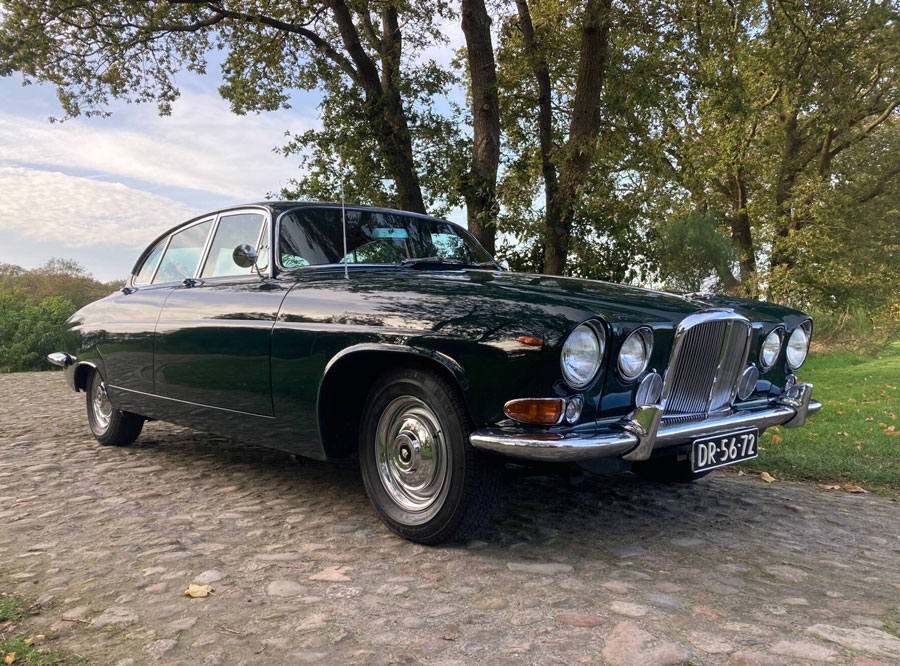
Launched in 1966, the 420 refined the S-Type formula with a stronger identity and one clear powertrain. Jaguar offered the 4.2-litre XK engine, which sharpened its performance image and gave the car a muscular, relaxed character. Designers also replaced the earlier rounded nose with a more upright, four-headlamp front inspired by the larger 420G. The result looked more formal, more modern, and more imposing than the S-Type.
The mechanical package was equally persuasive. The 420 used independent rear suspension, servo-assisted disc brakes, and the familiar XK straight-six. The engine’s strength was not only peak power, but torque. It made the car feel effortless, especially at cruising speeds. Drivers could cover distance quickly without constant gear changes. In manual form, especially with overdrive, the 420 became a capable long-distance express. In automatic form, it leaned more toward relaxed luxury, but still retained the basic performance expected from a Jaguar.
Inside, the 420 offered the traditional Jaguar atmosphere: leather, wood veneer, clear instruments, and a sense of occasion. Yet it was not merely decorative. The cabin was comfortable, the boot was practical, and the car had enough rear-seat space to work as family transport. That combination made it attractive to buyers who wanted one car to do almost everything.
The Daimler Sovereign connection
The 420 also appeared as the Daimler Sovereign. This was an important moment because it was the first Jaguar saloon to be badge-engineered into a Daimler with very little mechanical difference. The Daimler version used the same basic body and Jaguar engine, but received Daimler badging, a fluted grille, plusher trim details, and a more formal image.
This distinction mattered in the 1960s. Jaguar carried a younger, more sporting character. Daimler suggested tradition, status, and discreet luxury. Mechanically, the cars were closely related, but they appealed to slightly different buyers. The Jaguar 420 was the sharper choice. The Daimler Sovereign was the more conservative and dignified expression of the same idea.
Today, both versions are interesting. The Jaguar has the stronger sporting identity, while the Daimler has an understated charm. For collectors, condition and originality often matter more than the badge. A well-preserved Sovereign can be just as desirable as a good 420, especially if it retains its correct trim and interior details.
Why the 420 was short-lived
Despite its ability, the Jaguar 420 had a brief production life. Jaguar built 10,236 examples of the 420, while Daimler Sovereign production reached 5,824 cars. The Jaguar 420 was produced from 1966 to 1968, and the Daimler Sovereign continued until 1969.
The reason was not failure. In many ways, the 420 was a victim of timing. Jaguar was preparing the XJ6, launched in September 1968, which would rationalise the company’s saloon range and become one of the greatest luxury saloons of its era. The XJ6 took the best parts of Jaguar’s 1960s saloon thinking—refinement, independent suspension, XK power, graceful styling—and placed them in a new body. Jaguar Heritage describes the XJ6 as being launched in September 1968 with 2.8-litre or 4.2-litre XK engines and a new body.
In that sense, the 420 was a bridge. It connected the Mk 2 and S-Type era with the coming XJ generation. It showed Jaguar where the market was going: buyers wanted performance, but they also wanted comfort, refinement, safety, and modern styling. The 420 proved the formula just before the XJ6 perfected it.
Driving character: elegant speed without drama
The 420’s charm lies in its combination of effortlessness and involvement. It is not a small car, but it feels more agile than its luxury appointments suggest. The XK engine gives a strong, smooth surge rather than a frantic rush. The independent rear suspension helps the car ride with composure, while the brakes give confidence when driven briskly.
Classic & Sports Car describes the 420 as usable, comfortable, fast, and fun without being tiring. It also highlights the car’s strong brakes, independent rear suspension, alternator charging, and Marles Varamatic steering as part of its appeal.
That is the essence of the model. It is a car for covering ground quickly and quietly. It feels expensive, but not remote. It can be enjoyed on a country road, driven to a weekend event, or used for relaxed touring. It may not have the glamour of an E-Type or the racing mythology of the Mk 2, but it delivers a very complete driving experience.
What to check when buying one
Like many British classics of the period, the Jaguar 420 rewards careful inspection. Rust is the main concern. Bodywork can be expensive, and some panels are specific to the model. Inner sills, floor sections, wheel arches, door bottoms, jacking points, front wings, rear suspension mounting areas, and the boot floor all deserve close attention.
The engine is generally strong, but poor cooling-system maintenance can cause problems. The 4.2 XK unit needs clean coolant, proper antifreeze, and a healthy radiator. Signs of overheating, head-gasket issues, oil contamination, or poor oil pressure should be taken seriously. Classic & Sports Car notes that internal corrosion can clog waterways and lead to overheating or head-gasket failure if not controlled.
The rear suspension is one of the car’s strengths, but it is also complex. Worn bushes, tired dampers, seized rear calipers, weak handbrakes, and corrosion around suspension mounts can quickly turn a promising car into a major project. The automatic transmission is generally durable, while manual cars with overdrive are especially desirable for enthusiastic driving.
Interior condition is also important. Leather, wood veneer, instruments, switches, carpets, and trim pieces can be expensive to restore properly. A tired interior may be charming, but a missing or badly damaged one can be costly. Originality matters because the 420 has details that are harder to source than those for better-known Jaguars.
A collector’s car still under the radar
The Jaguar 420 remains less famous than the Mk 2, E-Type, and XJ6. That relative obscurity can make it appealing. It offers much of the classic Jaguar experience—XK power, wood and leather, graceful styling, and a refined chassis—without the same level of market attention.
It also has rarity on its side. With just over ten thousand Jaguar-badged cars built, it is not common. Yet it is not so rare that ownership becomes impossible. Mechanical parts availability is helped by shared Jaguar components, although body and trim items require more patience.
For collectors who value driving quality over pure fame, the 420 makes a strong case. It is elegant, quick, comfortable, and historically important. It represents the final development of Jaguar’s compact 1960s saloon line before the XJ6 changed the company’s direction.
Protecting a Jaguar 420 today
A car like the Jaguar 420 deserves careful storage. Its paint, chrome, wood, leather, and rubber seals all suffer when exposed to dust, humidity, sunlight, and temperature changes. Even indoor storage can leave a classic vulnerable to fine scratches, moisture, and accidental marks.
A tailored indoor car cover is a sensible way to protect the bodywork while allowing the car to breathe. The fit matters because the 420 has distinctive proportions, a long bonnet, delicate chrome details, and pronounced front wings. A loose universal cover can move against the paint and cause rubbing. A proper custom-fit cover follows the car’s shape more closely and gives better protection during long periods of storage.
For cars kept in a garage, a soft breathable indoor cover is usually the best option. For vehicles stored in a semi-open space or transported to events, a stronger outdoor or transport cover may be more suitable. In either case, the aim is preservation. A Jaguar 420 is not only a vehicle; it is leather, wood, steel, chrome, and engineering history. Protecting those materials helps preserve both enjoyment and value.
The final word
The Jaguar 420 may not be the most famous classic Jaguar, but it is one of the most balanced. It took the sporting saloon formula of the Mk 2, added the refinement of the S-Type, borrowed visual authority from the larger 420G, and pointed directly toward the XJ6. That makes it more than a transitional model. It is a key chapter in Jaguar’s saloon story.
It has speed without aggression, luxury without excess, and character without theatricality. It is the kind of car that grows more interesting the more closely you study it. For enthusiasts who want a classic Jaguar they can drive, admire, and understand as part of a wider lineage, the 420 remains a compelling choice.
In the end, the Jaguar 420 was not overshadowed because it lacked quality. It was overshadowed because the XJ6 arrived so soon after it and rewrote the rules. Yet that should not diminish the 420’s appeal. It was a compact sports saloon with real sophistication, real performance, and a quietly important place in Jaguar history.