
Road Cars That Wear Racing Crowns
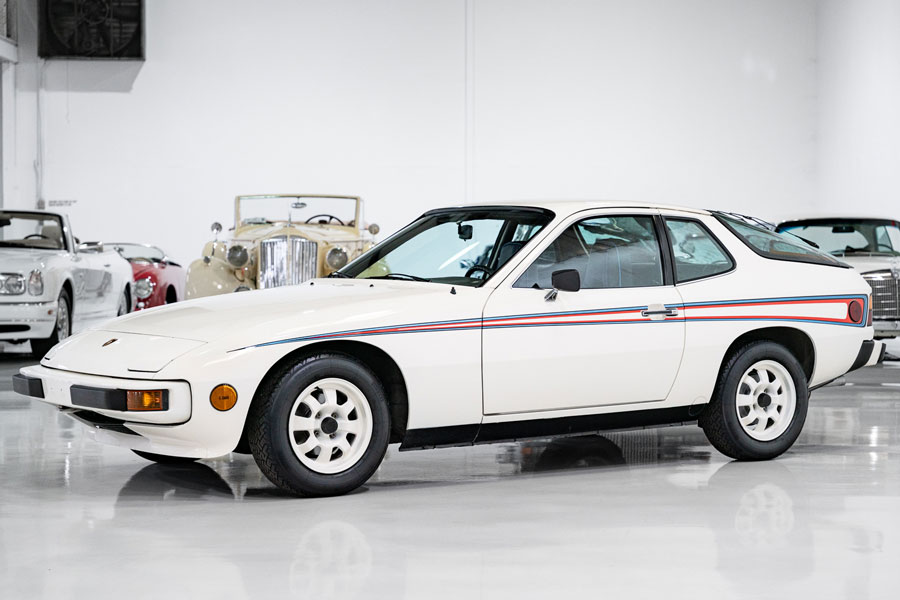
Porsche 924 Martini Championship Edition at Life in Classic
Racing Heritage on the Road
Win on Sunday, sell on Monday. Many carmakers have lived by that creed, and a few have worn their victories with pride. Jaguar, Porsche, Triumph, and Lotus each built road cars that quietly, and sometimes boldly, celebrated hard-earned success on the world’s circuits. Badges, plaques, and special trims linked showroom buyers with the glory of Le Mans, world championships, and national titles. These four classics, each listed for sale, show how competition pedigree can add meaning to everyday motoring. Moreover, they remind us that trophies do more than gather dust; they shape legends.
Racing laurels do not just flatter egos. They can guide engineering, spark limited editions, and fuel lasting enthusiasm. Consequently, when you spot a small badge on a dashboard or trunk lid, you see more than decoration. You see a story about grit, innovation, and the desire to be first past the flag.
Triumph Spitfire 1500: Small Car, Big Results
For an affordable British roadster, the Triumph Spitfire punched above its weight. Its brass dashboard plaque told the tale, tallying SCCA national championships across the late 1960s and early 1970s. On a 1978 car, the count highlights titles from 1965, 1968, 1969, 1970, 1971, 1972, and 1973. Later plaques kept pace, updating the run right to the end of production in 1980. The message was clear: humble size, serious bite.
Interestingly, Triumph had not designed the Spitfire for racing. Yet, within four years of launch, near-standard cars scored at Le Mans, Sebring, the Tour de France, and the Alpine Rally. That rapid ascent reflected a light, simple platform and clever development. It also gave owners a genuine reason to feel proud every time they turned the key.
The 1978 Spitfire 1500 profiled here uses the 1,493-cc inline-four that replaced the earlier 1,286-cc unit as emissions rules tightened. This example trades its original Zenith-Stromberg carb for a popular two-barrel Weber downdraft. It wears fresh Carmine Red paint, plus a newer reproduction interior. A JVC AM/FM cassette stereo with Alpine speakers and a trunk-mounted luggage rack round out the period vibe. The asking price is $14,995.
Porsche 924 Martini Championship Edition: Image Maker
No marque has collected silverware quite like Porsche. In 1977, the company marked that tradition with the 924 Martini Championship Edition. It wore Police White paint, bold Martini graphics, a distinctive cabin, and a console plaque honoring World Sportscar Championship titles from 1969, 1970, 1971, and 1976. The aim was simple. Give the new entry-level Porsche a dose of the brand’s racing aura.
The 924, introduced in Europe for 1976, launched Porsche’s transaxle era. With a front-mounted, water-cooled four driving the rear wheels, it broke from the 911’s formula. Early cars, including the Martini Edition, came with a four-speed gearbox, rear drum brakes, four-lug wheels, and a 2.0-liter OHC inline-four derived from Volkswagen’s LT van. Porsche improved the 924 steadily over time; however, the 1977 special leaned on style and story more than spec-sheet fireworks.
The featured car began life in California and returned to Germany about a dozen years ago. Its paint and upholstery present cleanly in photos, suggesting careful upkeep. As an icon of branding and momentum, it also captures a vivid 1970s moment. The asking price is $34,200.
Lotus Elan S3: Lightness Meets Laurels
The FIA awards the World Constructors’ Championship to Formula 1’s most successful team each season. Under Colin Chapman, Team Lotus took its first title in 1963 and repeated the feat in 1965 with Jim Clark, who in that same extraordinary 1965 season also won the Indianapolis 500 in Lotus’s revolutionary Type 38. Lotus did not let those achievements stay confined to the paddock. Period Elans carried small commemorative emblems, and Lotus specialists still list the Elan’s “World Championship 1963 & 1965” badge alongside a separate “Indy 500 1965” badge. On an Elan S3, those tiny pieces of trim say a great deal. They tell you that this was no ordinary British sports car, but a road machine built by a company at the very forefront of racing innovation.
What made the Elan such a fitting canvas for that message was the car itself. Lotus built it around a steel backbone chassis with a glass-reinforced body, a configuration that kept weight low while preserving stiffness. The model’s 1,558-cc twin-cam engine, four-wheel independent suspension, and four-wheel disc brakes gave it a level of agility and sophistication that felt years ahead of many contemporaries. In other words, the Elan did not need racing badges to seem special. Yet the badges sharpened the story. They linked the car’s famously delicate steering and featherweight responses to the same engineering mindset that had already conquered Formula 1 and Indy.
That is why the Elan remains such a compelling expression of “win on Sunday, sell on Monday.” It was not a muscle car dressed up with decals, nor a grand tourer pretending to be a racer. It was a genuinely advanced driver’s car whose competition links felt natural. Even today, those little emblems seem perfectly judged. They do not shout. They simply confirm what the first corner already tells you.
Jaguar XK140: Le Mans on the Boot Lid
If Lotus wore its honors with understatement, Jaguar took a more direct route. The XK140 arrived in late 1954 as a development of the XK120, and one of its distinguishing details was a boot-lid badge reading “Winner Le Mans 1951-3.” That flourish tied the car explicitly to Jaguar’s early endurance-racing success and turned the rear of the road car into a rolling reminder of the firm’s greatest stage. It was wonderfully confident branding, and also entirely in character for a company whose sporting credibility had become central to its identity.
The XK140 had substance to back up the symbolism. Compared with the XK120, it brought meaningful mechanical and usability improvements, including rack-and-pinion steering, more cockpit room, and a generally more developed feel. That mattered because Jaguar’s appeal was never only about outright speed. The company excelled at blending performance, elegance, and long-distance comfort, which is precisely why Le Mans mattered so much to the brand. The XK140 translated that endurance-racing glow into a road car that could be fast, handsome, and civilized all at once. The badge was not an afterthought. It was a summary.
Seen now, the XK140’s Le Mans emblem feels especially charming because it belongs to an era when manufacturers were still learning how to market motorsport success without cynicism. Jaguar did not bury the connection in a brochure footnote. It put it where everyone could see it. That honesty gives the car an added layer of charisma today. The badge is decorative, certainly, but it also reflects something real: the moment when Jaguar’s race program helped create one of the most desirable road-going sports cars of its generation.
Why These Cars Still Matter
Together, these four classics show the many ways racing success can filter into road-car culture. Triumph used a dashboard plaque to celebrate national titles earned by an underdog. Porsche wrapped a new front-engined coupe in the imagery of world championship success. Lotus fitted tiny emblems that quietly connected its road cars to grand prix brilliance and Indy glory. Jaguar, by contrast, stamped Le Mans directly onto the boot lid and let the world read it at a glance. Different methods, same purpose. Each maker found a way to turn competition into memory, and memory into desire.
That is why these details still resonate. They are not mere decorations, nor cheap nostalgia. They are clues to the ambitions of the companies that built the cars and to the eras that shaped them. In the best cases, they also feel earned. When you notice a brass plaque, a console script, or a Le Mans badge on a trunk lid, you are seeing more than branding. You are seeing a road car that carries part of the circuit home with it.