
Porsche 356 Barn Find: A Super 90 That Slept for 45 Years
Porsche 356 Barn Find at Life in Classic
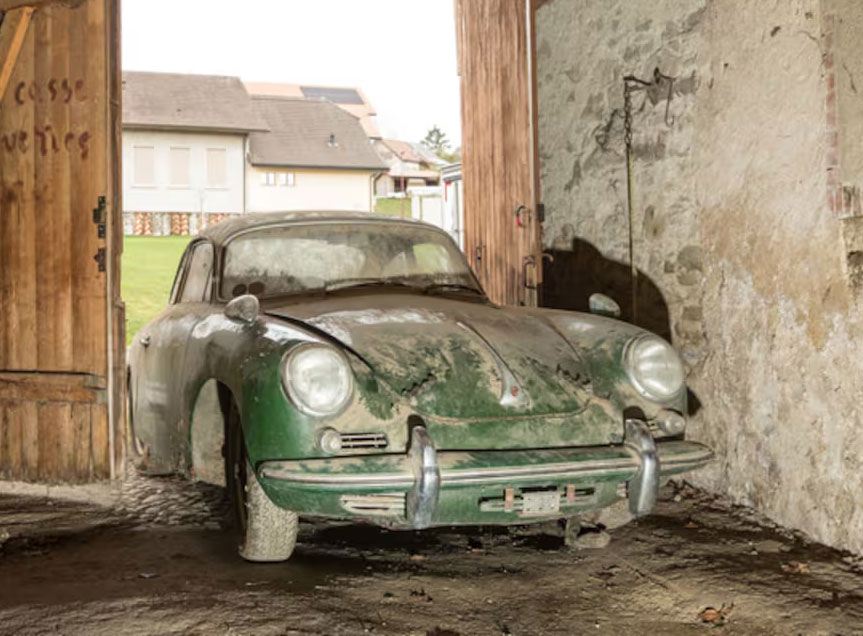
This Porsche 356 barn find has the kind of story collectors still dream about. A 1963 Porsche 356 B T6 Super 90, delivered new in Switzerland and reportedly parked since 1981, has reappeared after 45 years in storage. It will be offered by Oldtimer Galerie Toffen at the Swiss Classic World auction in Lucerne on May 30, 2026, with an estimate of CHF 30,000 to CHF 40,000 and no reserve.
At first glance, it has all the ingredients of a classic discovery: faded charm, long-term silence, low indicated mileage, and the irresistible outline of an early Porsche coupé. Yet the real appeal is not just the dust or the auction estimate. It is the human story behind the car. This was not a collector’s trophy hidden away for financial reasons. According to the auction listing, it was bought by its last long-term owner in the early 1970s, repaired, repainted, used for a wedding, driven regularly, and then quietly stored away.
Why This Porsche 356 Barn Find Matters
A Porsche 356 barn find is always interesting, but this example stands out because it combines a desirable specification with a credible private history. The car is a 356 B T6 Super 90, one of the more appealing versions of Porsche’s first great production sports car. It dates from the final phase of 356 B production, shortly before the 356 C arrived with standard disc brakes and before the 911 began to change the company’s future.
The 356 B itself was introduced in 1959 as a more developed version of the original formula. Compared with earlier cars, it brought technical and stylistic changes, including higher bumpers, improved lighting, and more powerful engines. For the 1962 model year, the T6 update added details such as two air intake grilles on the engine cover, an external fuel filler under a flap on the right front wing, a flatter fuel tank, and larger windows. Porsche’s own 356 B model guide also identifies the T6 by its widened bonnet and front-right fuel filler.
The Super 90 specification adds another layer of interest. Its 1.6-litre air-cooled four-cylinder boxer engine was rated at 90 hp, which was meaningful performance for a compact early-1960s sports car. It was not the complex four-cam Carrera engine, but that is part of the appeal. The Super 90 offered stronger performance while remaining closer to the simpler pushrod 356 ownership experience that many enthusiasts still value today.
This particular car was first registered in Switzerland in July 1963. The listing says the last owner acquired it in the early 1970s, then had the engine overhauled at the end of 1976. The coupé was also repainted in the green it still wears today. Once the work was complete, the Porsche reportedly served as transport for the owner’s wedding, a detail that gives the car a more personal character than the usual “parked and forgotten” headline.
That wedding story matters because it changes how we see the car. Many barn finds are described as sleeping treasures, but the best ones feel connected to real lives. This 356 was not merely stored as an asset. It was used, cared for, celebrated, and then gradually overtaken by time. Its story is not one of glamour, but of attachment.
The documentation appears to support that slower rhythm. A logbook kept from August 1977 records regular use and maintenance. The final entry was made at the end of 1981, when the odometer showed 62,420 km. Around 100 km later, the Porsche was placed in a barn, where it remained for the next 45 years. Following the owner’s death, his heirs rediscovered the coupé and recovered it from that barn in March 2026.
The Porsche Before the 911
To understand why this Porsche 356 barn find attracts attention, it helps to remember what the 356 represents. Before the 911 became the defining Porsche shape, the 356 established the company’s road-car identity. Porsche states that the 356 “No. 1” Roadster received its general operating permit on June 8, 1948, a date generally considered the birth of the Porsche brand. That first car used modified Volkswagen-based mechanical components and placed its flat-four engine ahead of the rear axle; series-production 356 models later moved to a rear-mounted layout.
The production 356 created a language that Porsche would keep refining for decades: light weight, compact size, careful engineering, and a rear-engined character that demanded respect but rewarded finesse. It was not about overwhelming power. It was about momentum, balance, grip, and the particular sound of an air-cooled flat-four working hard.
By 1963, the 356 had become more polished than the earliest cars, but it had not lost its essential simplicity. The T6 body made the car more practical and mature, while the Super 90 engine gave it useful extra urgency. For many enthusiasts, that combination is especially attractive. It is late enough to be usable, but still unmistakably part of the original Porsche era.
Restoration, Preservation, or Recommissioning?
For the next owner, this Porsche 356 barn find presents a familiar dilemma: restore it fully, preserve its age, or choose a careful mechanical recommissioning that keeps the car’s visible history intact. The auction listing describes it as an excellent basis for restoration, notes that the original engine is still fitted, and says the indicated 62,519 km likely corresponds to the original mileage according to the documentation. It will also be handed over with numerous documents and a 1974 vehicle registration certificate.
A full restoration would be tempting. A properly restored 356 B T6 Super 90 is a valuable, usable, elegant classic with global appeal. Fresh paint, rebuilt mechanicals, renewed trim, and a clean underside would make the car easier to use and easier to present at events. Yet there is always a cost beyond money. A complete restoration can erase the very texture that made a barn find interesting in the first place.
A more sympathetic approach may suit this car better. The engine, brakes, suspension, fuel system, wiring, and rubber components will all need careful inspection after such a long period of inactivity. Safety must come first. However, the exterior, interior, documents, and signs of age could be preserved where possible. The goal would not be to make the Porsche look as if the last 45 years never happened. It would be to make it drive again while allowing its past to remain visible.
That kind of preservation has become increasingly respected in the classic car world. Perfection still has its place, especially at concours level, but originality and continuity now carry their own form of prestige. A car that retains evidence of its life can feel more compelling than one restored beyond recognition. This 356’s green repaint, wedding anecdote, Swiss paperwork, maintenance log, and long silence all contribute to its identity.
A Quietly European Discovery
There is something particularly European about this story. In the United States, barn-find mythology often involves dry desert storage, muscle cars, large garages, and dramatic family legends. This Swiss example feels more restrained. The paperwork matters. The mileage matters. The storage period is long but believable. The car’s appeal comes not from spectacle, but from understatement.
That suits the Porsche 356. It was never a loud car in the American sense. It did not rely on displacement, chrome excess, or visual aggression. Its confidence came from engineering discipline and compact purpose. Even in Super 90 form, it remained a car of precision rather than theatre. That is why the image of a dusty green 356 emerging from a Swiss barn feels so appropriate. It is romantic, but not exaggerated.
The auction estimate also adds intrigue. CHF 30,000 to CHF 40,000 is modest compared with many restored 356 values, but it reflects the reality of the work ahead. A buyer will not simply be purchasing a charming story. They will be taking on a serious project involving mechanical recommissioning, structural assessment, parts sourcing, and careful decision-making. The no-reserve format means the market will decide how much this combination of rarity, documentation, condition, and emotion is worth on the day.
More Than Dust and Hype
The classic car world sometimes overuses the term “barn find.” A layer of dust can become a marketing tool, and a neglected car can be made to seem more important than it is. This Porsche deserves more careful treatment. Its value is not simply that it was hidden. Its value is that it appears to have survived with a coherent story still attached.
It was delivered in Switzerland, registered in 1963, acquired by a long-term owner, repaired, repainted, used for his wedding, logged through years of use, stored in 1981, and recovered by heirs in 2026. That is a complete narrative arc, and it is exactly the kind of continuity that collectors increasingly appreciate. The car is not just a restoration candidate. It is a witness.
When it crosses the block in Lucerne, the final price will attract attention. Yet the more important question is what happens next. A purely financial buyer may see margin. A restorer may see potential. But the right custodian will see a responsibility: to bring the Porsche back without stripping away the story that made it worth saving.
After 45 years of silence, this Porsche 356 barn find has returned at the right moment. The 356 is old enough to feel historic, beloved enough to be understood, and mechanically straightforward enough to inspire restoration rather than intimidation. In a market full of polished classics, this dusty Super 90 feels honest. It reminds us that cars do not become legends only on racetracks or concours lawns. Sometimes, they become legends by waiting quietly, until someone opens the barn door.