
Mopar Spring Fever in Pink and Green
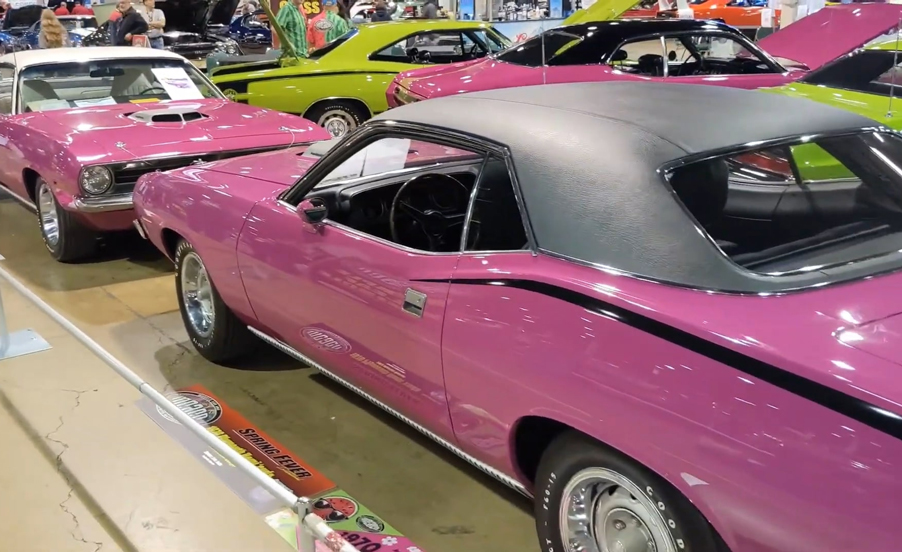
MCACN’s Spring colors - Life in Classic
High-Impact Hues That Shouted Mopar
Every spring, American automakers pushed fresh ideas to pull shoppers back to showrooms. Plymouth and Dodge did more than that in 1970. They unleashed two high-impact paint codes that still stop traffic: FM3 and FJ6. FM3 meant Moulin Rouge for Plymouth and Panther Pink for Dodge. FJ6 translated to Sassy Grass Green for Plymouth and Green Go for Dodge.
Both colors were rare, and both were unforgettable. However, the magenta shade quickly became the headline act. Collectors chase it today, and factory FM3 cars often bring a premium. By comparison, FJ6 is equally scarce for 1970. Yet Dodge and Plymouth carried that green into 1971 on some models. As a result, it tends to live in FM3’s bright shadow. Even so, both colors defined the era’s bravado, from thin stripes to full body panels drenched in neon.
Notably, Dodge paired a magenta side stripe with Panther Pink on some cars. The exact combination count remains unclear, which only fuels the legend.
Spring Options Beyond the Paint Can
The vibrant paints arrived with a larger bundle of spring features. Some items were delayed from the model-year launch. Others were truly new. Either way, the season gave the Dodge Challenger and its Plymouth stablemates fresh energy. Period brochures teased special stripes, wheels, and trim that matched the punch of FM3 and FJ6. Moreover, the updates extended across body styles and performance tiers.
Chrysler’s marketing leaned into the look. Bright paint set the tone, while blackout hoods, bold tape stripes, and unique interiors completed the mood. Additionally, stripe treatments varied by model, even on similar cars. Two 1970 Charger R/Ts, for example, could wear noticeably different graphic packages. Meanwhile, the Challenger R/T hardtop run counted 41 cars for 1970 in FM3. How many added the magenta stripe is unknown, but the pairing made for an unforgettable sight.
MCACN’s Spring Fever Invitational Delivers
At the 2025 Muscle Car and Corvette Nationals, fans saw this color story come alive. The Spring Fever Invitational gathered Mopar A-, B-, and E-bodies in both FM3 and FJ6. It even included a special-order C-body finished in Moulin Rouge. The effect was dazzling. Under bright lights, the greens looked electric. The magenta tones glowed like neon.
The exhibit also explored how paint played with performance. AAR ’Cudas and Challenger T/As stood side by side, wearing their Trans-Am swagger. Their stances, strobe stripes, and side-exit exhausts made a strong case for showroom racing style. Furthermore, engines ranged from high-winding small-blocks to thundering Hemis. Together, they told a clear story: bold color and bold power belonged together in 1970.
Rare by the Numbers
Rarity drives mystique, and these cars have it in spades. Approximately 37 1970 Dodge Super Bee hardtops left the factory in Green Go. Around 27 1970 Dodge Charger 500s wore the same FJ6 shade. By contrast, the 1970 Plymouth Duster 340 saw roughly 414 cars in Moulin Rouge. That number tops most other models and shows how well FM3 fit Plymouth’s A-body.
Convertibles in these hues are a special treat. Would you believe only five 1970 Plymouth Road Runner convertibles came in Sassy Grass Green? At least three 1970 ’Cuda convertibles were sprayed in Moulin Rouge, including examples powered by the 340 small-block. Meanwhile, two Moulin Rouge Hemi ’Cudas are known to survive, though the original production figure remains unknown.
Special orders add more intrigue. A 1970 Plymouth Fury III hardtop appeared in Moulin Rouge, complete with a white painted roof. Additionally, some FM3 cars featured painted black tops that sharpened their contrast. Elsewhere, enthusiasts noticed how striping could change the whole attitude. Two Charger R/Ts with different stripes proved that point in one glance. Moreover, the AAR ’Cuda and Challenger T/A pairing underscored how competition cues and color worked hand in hand.
Please note: the production figures above reflect U.S. shipments only. They exclude Canadian-built cars and exports. Because factory records are incomplete, totals do not represent full production.
Why These Colors Still Matter
FM3 and FJ6 were more than paint codes. They were statements about personality and speed. Today, collectors prize them because they represent a fearless moment in American design. FM3 often commands higher prices, and for good reasons. The shade is rare, dramatic, and closely tied to performance models. However, FJ6’s carryover into 1971 gives it breadth across more cars and trim levels. Consequently, it remains a favorite among purists who value year-to-year nuance.
Beyond value, these colors make people smile. They draw crowds and spark stories about first cars, late-night cruising, and showroom dreams. Furthermore, their survival depends on careful restoration and thoughtful care. With the right preservation, FM3 and FJ6 will keep turning heads for decades. In short, Mopar’s spring fever never cooled. It just found a permanent home in the enthusiast world.