
How BMW’s Tiny 700 Saved the Brand
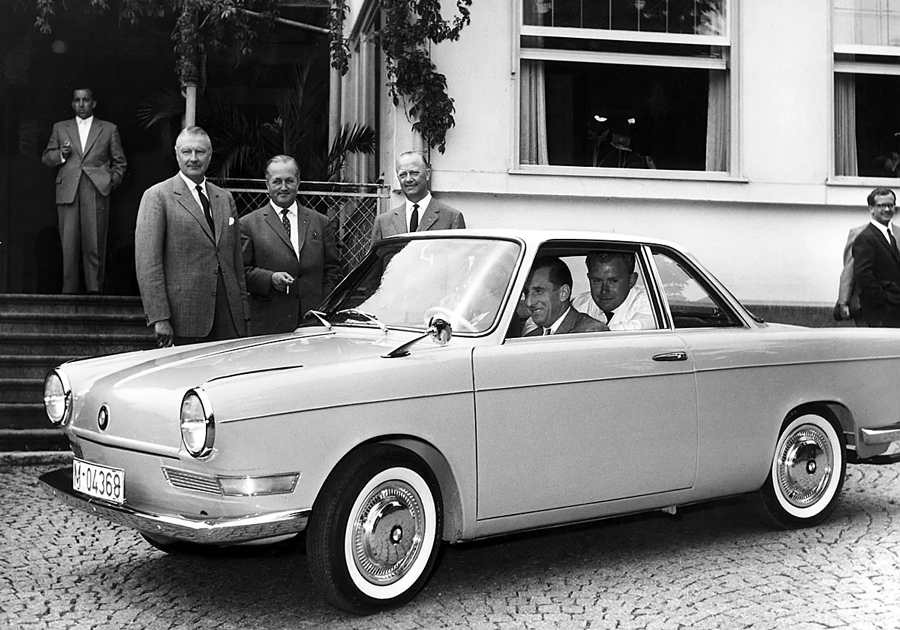
BMW 700 at life in classic
The BMW 700 was the little car that carried a big responsibility. Launched in the fall of 1959, it arrived at a precarious moment for the Bavarian automaker, which was flirting with financial collapse. The 700 not only stabilized the company’s fortunes, it also bridged two eras: the quirky Isetta microcars that had kept BMW afloat after the war and the forward-looking Neue Klasse sedans that would define its modern identity. Without this modest, rear-engined runabout, BMW as we know it may have been absorbed by Daimler-Benz.
For such a small machine, the 700 had an impressive pedigree. Italian designer Giovanni Michelotti shaped its clean, contemporary lines over a platform derived from the BMW 600—a larger, two-door evolution of the Isetta. With the engine tucked behind the rear axle and a simple, lightweight structure, the 700 proved an agile city car with surprising long-distance stamina. Its 697-cc, air-cooled flat-twin, borrowed from BMW’s motorcycle expertise, paired with a fully synchronized four-speed manual, delivered sprightly performance by the standards of the day. British magazine Motor Sport praised its lively character and declared it great fun to drive, capturing the charm that won over buyers across Europe.
The car’s path to production was equally compelling. Michelotti became involved at the suggestion of Wolfgang Denzel, BMW’s Austrian distributor, who commissioned a coupe concept on a lengthened 600 chassis. BMW liked what it saw but also anticipated demand for a practical sedan, and requested a taller-roof variant. In-house designers, led by Wilhelm Hofmeister—whose name later became synonymous with the signature “Hofmeister kink”—helped refine Michelotti’s proposals. The final 700 made BMW history as the brand’s first car to use unit-body (unibody) construction, a forward-thinking step that would become standard for the company.
As the model matured, BMW added more comfort and polish. In 1961 the company introduced the 700 Luxus, equipped with features aimed at elevating the ownership experience: an electric clock, crisp circular instruments, imitation-leather wear strips on the seats, an oil-pressure warning light, a larger steering wheel for ease of control, pivoting vent windows, and back-up lights. For 1962, the wheelbase stretched and the trunk grew, adding usability without spoiling the car’s tidy proportions. The premium variant was then renamed LS Luxus, and both sedan and coupe versions remained in production through 1965.
Today, surviving 700s are uncommon, and well-preserved or thoughtfully restored examples highlight just how pivotal this model was to BMW’s trajectory. That’s what makes a 1964 BMW 700 LS Luxus currently offered in Winnipeg, Manitoba, so intriguing. It’s a running and driving project that invites the next owner to finish what a previous collector began.
Checkout Cover Company for a fine car cover for your classic BMW.