
Ponton Elegance of the 1959 Mercedes-Benz 220S Cabriolet
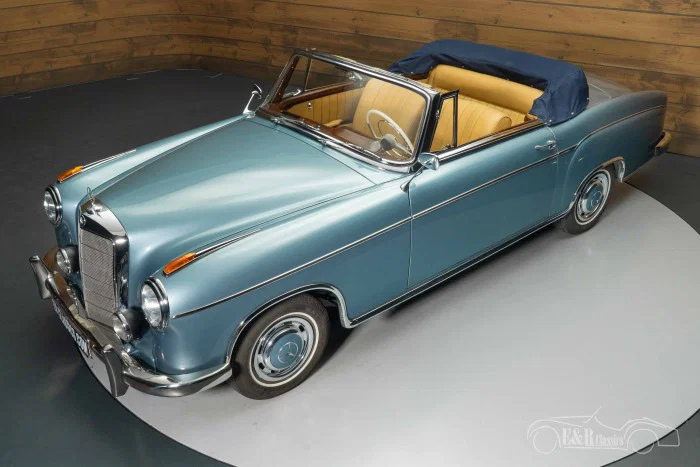
Mercedes-Benz 220S Cabriolet at Life in Classic
From Flagship Glamour to Everyday Reach
In the 1950s, Mercedes-Benz commanded attention with its imposing 300 series. Admirers even called them “Adenauer,” after West German Chancellor Konrad Adenauer, who favored the model. Yet those stately cars sold in modest numbers. To thrive in a fast-modernizing market, the brand also needed a higher-volume family of cars.
Earlier postwar models, like the 170 and 220, still wore prewar lines. Customers, however, wanted something fresher. Reconstruction-era Europe also demanded efficient engineering and modern packaging. Therefore, Mercedes-Benz turned to a new design language that promised cleaner aerodynamics, more interior space, and contemporary style. The result would reshape the company’s future and set a template many rivals would follow.
The Rise of Ponton Design
The “ponton,” or pontoon, look emerged as designers blended headlamps into flowing fenders and smoothed the body sides. The rounded forms suggested the buoyant shape of a pontoon, hence the name. Many makers adopted the idea, including Nash, Renault, Ford, and Volvo. Mercedes-Benz, however, embraced it with uncommon depth and discipline.
Beyond a new profile, the company advanced the engineering under the skin. The first ponton models arrived in 1953 on the W120 platform with overhead-cam four-cylinder engines. Crucially, they introduced unitized construction to the brand. That structure reduced weight and increased rigidity. As a result, the cars felt solid yet modern, and they prepared the ground for more powerful versions.
Engineering the W180 and the 220S
When Mercedes-Benz moved to six cylinders, the platform grew with it. The W180 series, launched in 1954, rode on a longer wheelbase. That extra span created better proportions and more cabin room. It also improved ride quality. The flagship of this line, the 220S, arrived in 1956 and sharpened the formula even further.
Under the hood sat a 2,195-cc overhead-cam inline-six. Higher compression and a dual-carburetor intake gave it verve. Mercedes rated the engine at 106 hp DIN, equivalent to 124 hp SAE. The factory offered sedans for daily duty, as well as elegant two-door coupes and cabriolets for buyers seeking something special. Thus, the ponton series balanced practicality with poise.
A Rare 1959 220S Cabriolet in Focus
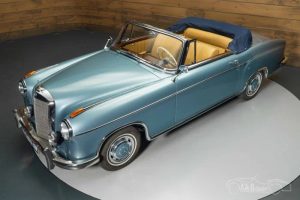
Among the most coveted ponton variants is the 220S Cabriolet. Only 2,178 examples left the factory, and survivors remain sought after. A restored 1959 car in Light Blue illustrates why the model still captivates. The color complements the car’s smooth flanks and dignified grille, while the folding top underscores its relaxed grand-touring spirit.