
Mercedes-Benz at Retromobile 2026: the stand that turns history into an itinerary
Mercedes-Benz-190-SL-(W121)-roadster---Life-in-Classic
Retromobile has always been good at one thing: making the past feel urgent. You can arrive for the cars, but you stay for the way they reframe time—one hall will feel like a museum, the next like a trading floor, and somewhere in between you’ll find the kind of story you can only tell in Paris at the start of the season. In 2026, with the show marking its 50th edition, that mix feels even sharper. The organizers talk openly about building on the momentum of record crowds, and the broader market energy is visible everywhere, from the big auction presences to the manufacturer stands that now look like full-on exhibitions.
Mercedes-Benz understood the assignment. Their Retromobile 2026 stand does not try to “cover” a century of production. It picks a thread—Mille Miglia, post-war optimism, and the idea of the road as a proving ground—and then pulls it tight. The result feels less like a static display and more like a curated route map: where the cars matter, but the point is motion.
A Mille Miglia spine, with anniversaries in the background
The official Retromobile press material frames Mercedes-Benz’s presence around three overlapping anniversaries: 140 years since Carl Benz’s patent filing, 125 years since the Mercedes 35 hp’s success at Nice Week, and 100 years since the creation of Mercedes-Benz through the Benz & Cie and Daimler-Motoren-Gesellschaft merger. Then it lands the theme: a tribute to the brand’s Mille Miglia story, with the post-war era placed center stage.
That sounds like broad marketing language until you see how tightly it connects to the cars on the floor. The stand’s “main cast” is deliberately recognizable: a 300 SL, a 190 SL, and a W120 “Ponton” saloon. Even if you only know Mercedes classics in outline, those silhouettes do the work. They signal engineering confidence, continental speed, and a kind of aspirational normality that defined the 1950s.
The 300 SL Gullwing: a symbol, but also a specific argument
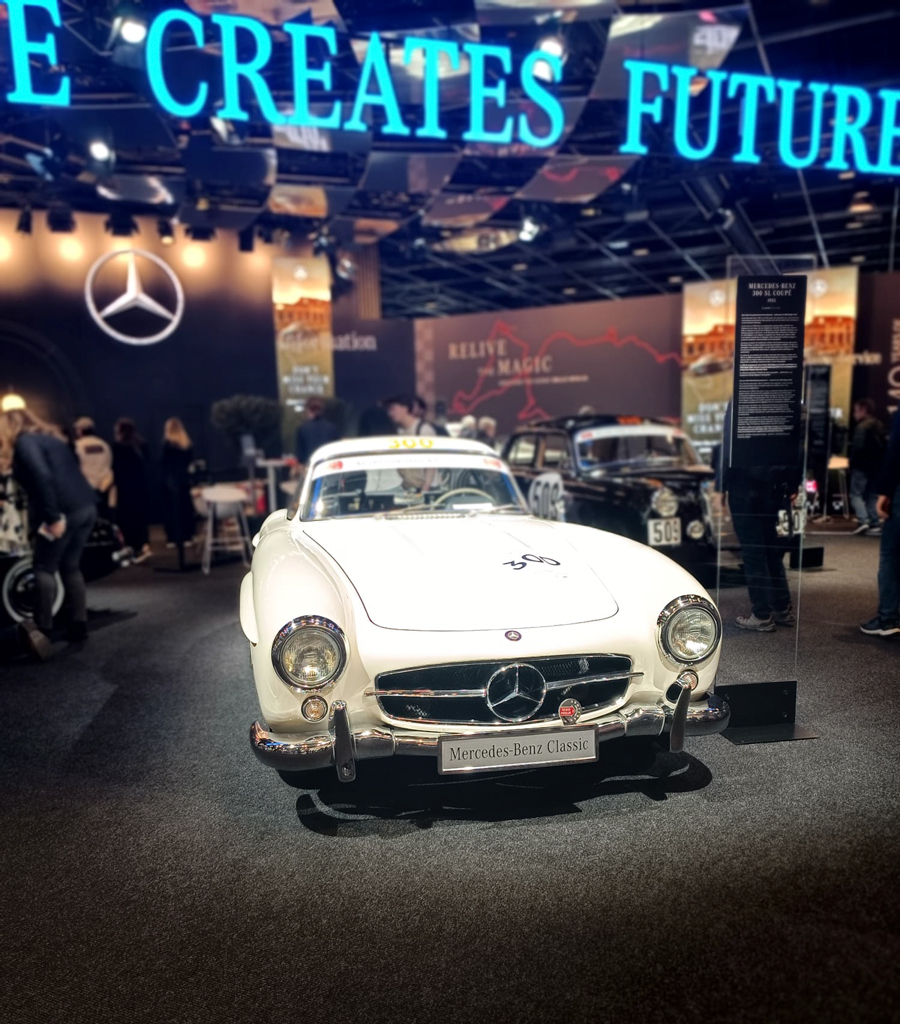
Your white car with “300” on the hood is the anchor because the 300 SL always is. It reads instantly, but the context matters. Retromobile’s own press pack points out that the road-going 300 SL drew directly from the competition coupe that won at Le Mans and the Carrera Panamericana in 1952, and it highlights Max Hoffmann’s role in pushing Mercedes to build the street version that debuted in New York in 1954.
That history is not just trivia here. The stand’s Mille Miglia framing turns the Gullwing into an argument about continuity: racing informs the road car; the road car returns to competition; the legend grows in both directions. The press pack even calls out the 1955 Mille Miglia entry where a 300 SL coupé, carrying start number 417, finished fifth overall. It’s a helpful detail because it keeps the story from becoming mythic haze. It also sets up one of the smarter moves around the stand this year: Mercedes-Benz Classic’s emphasis on experiences that go beyond ownership.
The 1955 300 SLR: the stand’s emotional peak
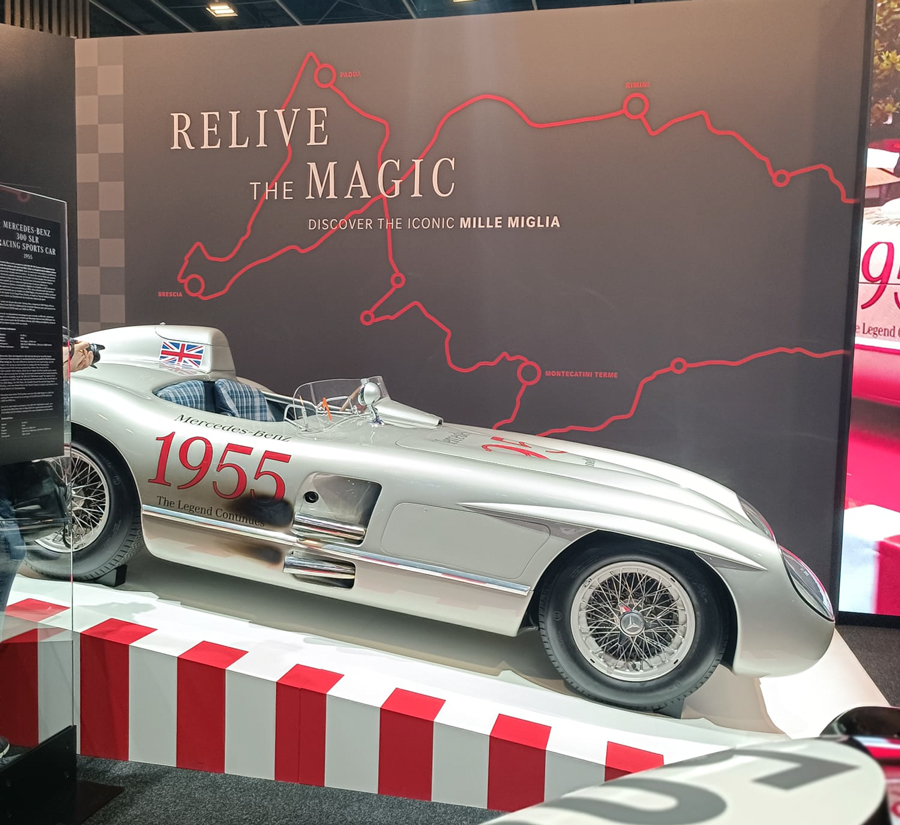
The silver car marked “1955” is where the air changes. Your photo catches the car in profile, backed by “Relive the Magic” and a Mille Miglia route graphic, and the on-stand placard identifies it plainly as a “Mercedes-Benz 300 SLR Racing Sports Car” from 1955. (That wording matters because it places the car as an object with a job, not just a jewel.)
In the broader Retromobile 2026 coverage, Mercedes-Benz’s 1955 Mille Miglia story is treated as defining: Stirling Moss and Denis Jenkinson’s outright win, plus the depth of results behind them. In practice, that means the 300 SLR does what great race cars always do at shows like this. It compresses everything around it. People stop talking about paint and start talking about speed, teamwork, and risk.
There’s another reason the SLR lands so well at Retromobile: it connects the stand’s “museum” mood to the event’s “market” mood. Even if this particular car is not for sale, it reminds visitors that Mercedes competition history sits at the very top of the collector ecosystem—where value, rarity, and cultural weight reinforce each other.
The 190 SL: the approachable counterpoint that still raced
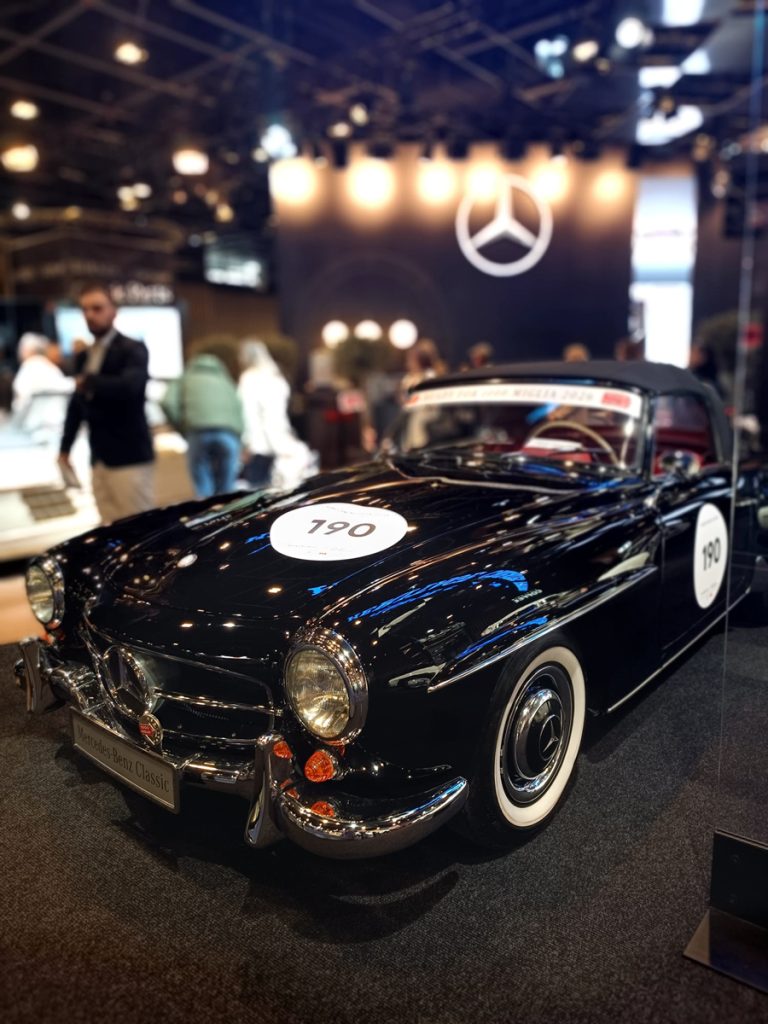
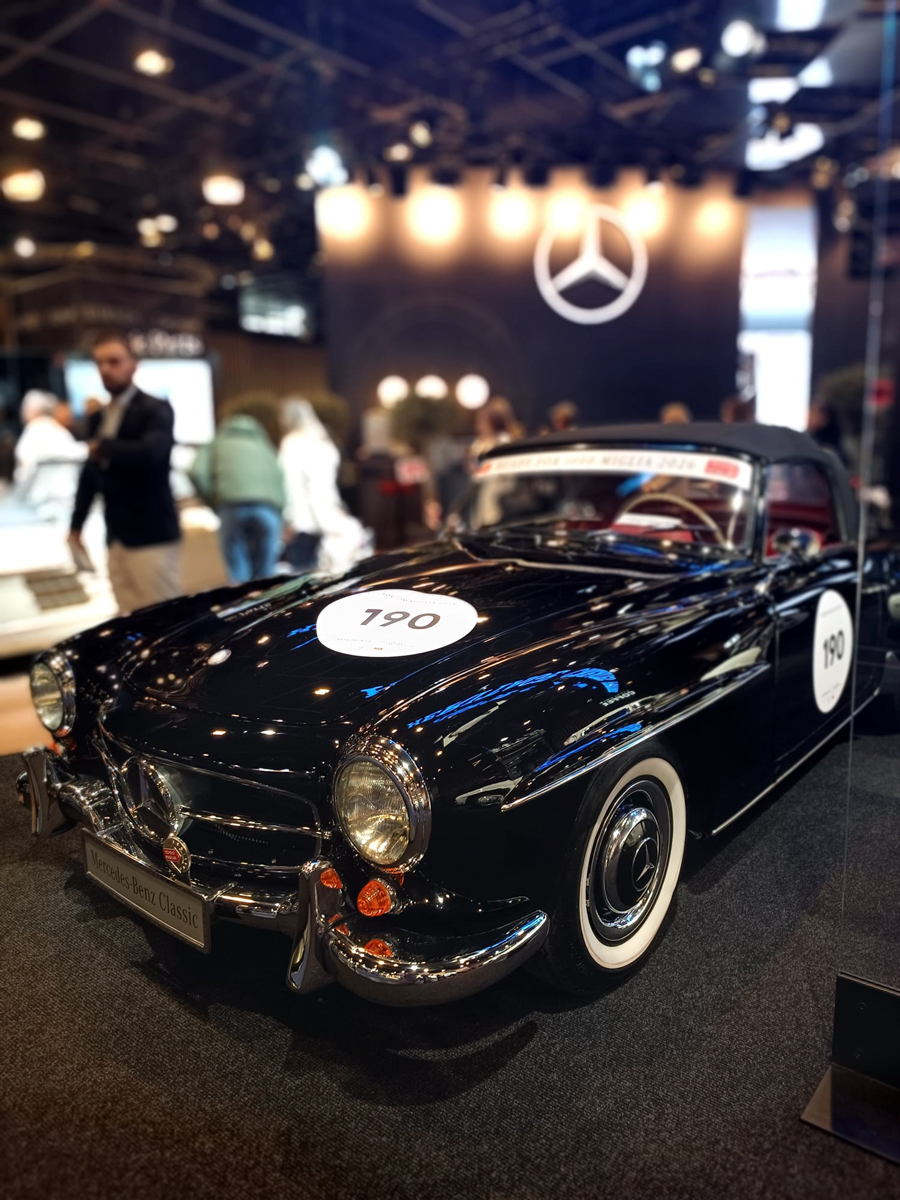
The black roadster with “190” in your photo plays a different role. It relaxes the room. It also broadens the Mille Miglia story beyond headline wins. Retromobile’s press pack notes that the 190 SL was conceived as the more accessible counterpart to the 300 SL, and it highlights a 1956 Mille Miglia entry (car number 347) that finished the event with a recorded time.
That is exactly why the 190 SL belongs here. It shifts the stand from heroic narrative to lived narrative. It suggests that the Mille Miglia was not only about outright victories. It was also about endurance, participation, and the social world that formed around the road race. In a Paris hall filled with million-euro decisions, the 190 SL quietly argues for charm and usability.
The “Ponton” and the idea of victory by a different measure
One of the most interesting facts in the official material is not about a sports car at all. The press pack points to the W120 “Ponton” saloon and references a Mercedes diesel-category win at the Mille Miglia in 1955. This is the stand’s subtle flex. It says Mercedes did not only win through spectacle. It also won through engineering pragmatism—efficiency, reliability, and the confidence to enter a family-shaped sedan into an event that could break purpose-built machines.
Even if visitors spend less time around the saloon than around the Gullwing, the story helps the whole display. It frames Mercedes-Benz’s heritage as a system rather than a single miracle model.
The “works-backed” modern layer: buying your way into the 1000 Miglia
Retromobile 2026 is not a nostalgia bubble. It is also a sales environment. Mercedes-Benz Classic leans into that reality with a program that effectively turns historic racing eligibility into a product. Reporting around the stand describes three 1950s Mercedes-Benz classics offered with a guaranteed starting place on the 1000 Miglia 2026 start line: a 1955 300 SL Gullwing (W198), a 1955 220 “Ponton” (W180), and a 1956 190 SL (W121). It also describes factory-backed support packages that position the buyer as part of a works-style presence.
This matters for two reasons. First, it reflects how the high end of the hobby is shifting: the “asset” and the “experience” now come bundled. Second, it changes the emotional logic of the stand. You are not only looking at the past; you are being invited to reenact it, with institutional support.
The barn-find 300 SL and the credibility of patina
Alongside the glamorous objects, Mercedes-Benz Classic also nods to restoration culture. Coverage of the stand mentions a barn-find 1960 Mercedes-Benz 300 SL discovered in Pennsylvania, presented as a candidate for factory-correct restoration by Classic Center specialists, and described as retaining matching numbers and original patina.
That is a savvy inclusion. It keeps the display from feeling too polished, and it speaks to a different kind of collector fantasy: not the fantasy of arriving finished, but the fantasy of bringing something back. In the Retromobile ecosystem—where restorers, specialists, and parts suppliers form a parallel economy—this kind of artifact lands with real weight.
Classic Partners in France: the aftercare message
Finally, Mercedes-Benz uses Retromobile as a platform for service infrastructure, not just storytelling. The same reporting notes the launch of the Mercedes-Benz Classic Partner network in France, including SAGA Classic locations, and places it within an international partner footprint.
For owners, that message is not glamorous, but it is decisive. A classic car’s value is tied to its support network. Mercedes is effectively saying: the stand is the front door, but the building is larger than the show.