
Nash Ambassador Suburban Among America’s Rarest Woodies
Nash Ambassador Suburban - Life in Classic
The Woodie Idea Goes Mainstream
In the early 1940s, wood moved from workhorse to showpiece. Chrysler proved it could elevate a production car’s image by treating timber as design, not just structure. Its 1941 Town & Country blended wagon utility with sedan grace and used varnished ash and mahogany as a bold style statement. Buyers responded. Chrysler built 996 “barrel-back” cars in 1941 and 999 more before wartime halted 1942 production. After the war, the formula returned in new forms. The quasi-wagon was replaced by a convertible and a sedan, both crafted with structural wood and shaped plywood panels. The idea sold. Between 1946 and 1948, Chrysler turned out more than 8,000 convertibles and 4,000 sedans.
Ford and Mercury noticed. Each launched a limited-production Sportsman convertible with ash framing and mahogany panels. The price ran roughly a third higher than a standard V-8 convertible, yet the allure was strong. Ford built just over 3,000 in three years, while Mercury’s venture lasted eight months and yielded 205 cars. Wood had become a visual shorthand for status.
Nash Seeks a Fresh Prestige Play
Meanwhile, Nash was rethinking its lineup. The new 1941 Nash 600 introduced a modern unit-body and took over the brand’s lower price slot. The Ambassador, once the marque’s luxury flagship, shared some looks with the 600 but rode on a separate frame with longer front sheetmetal to fit bigger engines. That overlap blurred the hierarchy. Some buyers now saw the Ambassador as a dressed-up 600 rather than a distinct premium car.
In 1946, Nash retired its long-serving straight-eight. The Ambassador and 600 both used sixes, but not equals. The Ambassador carried a 234.8-cu.in. overhead-valve straight-six with 112 hp. Nash touted strong power with thrifty 20-mpg cruising. In that postwar year, only Chrysler’s Royal six narrowly topped it at 114 hp. Even so, Nash needed more than numbers. Prestige depends on presence as much as spec sheets. The stage was set for a statement car.
Enter the Ambassador Suburban
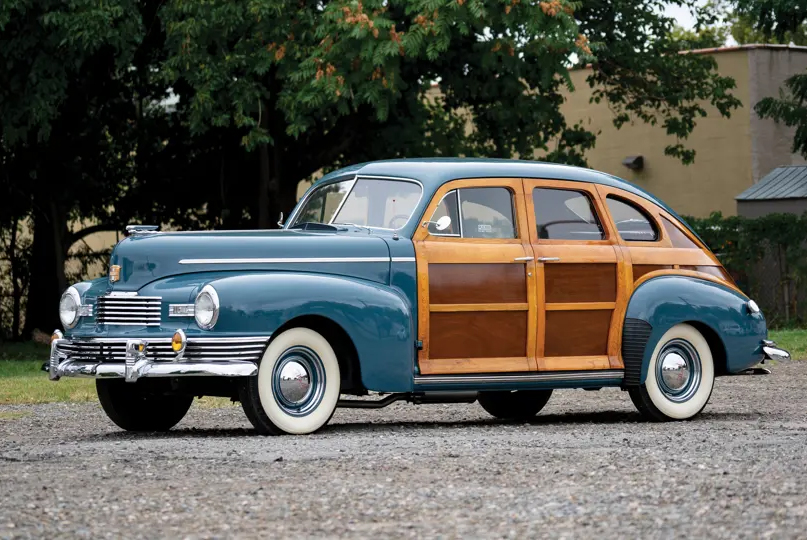
Nash answered with the 1946 Ambassador Suburban Sedan, a wood-sided flagship inspired by the Town & Country’s aura. The Suburban wore slim white ash framing with mahogany panels, all supplied by Ionia Manufacturing in Michigan. Seamon Body Company in Milwaukee assembled and affixed the wood to steel door, body, and trunk structures, much like Ford’s Sportsman. The tailored lumber added about 110 pounds to the standard Ambassador’s 3,360-pound curb weight.
The price underscored its mission. At $1,929, the Suburban cost $460 more than the comparable steel sedan. Production stayed deliberately small: 275 in 1946, 595 in 1947, and 130 in 1948, for 1,000 in total—only a tiny fraction of Nash’s output. Yet the Suburban delivered on equipment. Dual horns, a locking glove box, an electric clock, a dome light, and bumper guards came standard. Options included the forward-thinking Weather Eye heating and ventilation system, overdrive, turn signals, foam rubber cushions, and a Zenith radio with floor-mounted controls. Most novel of all, the rear seat converted into a double bed, a Nash hallmark promoted as ideal for travel and weekend escapes.
Why Nash Built So Few
Why invest in a woodie if you only build a thousand? Because image matters. Industry observers later suggested that the Suburban served as an “image builder,” designed to spotlight Nash’s innovation and craftsmanship. George Mason, the Nash-Kelvinator president, surely understood that the postwar seller’s market would cool. When it did, brands with a memorable identity would stand taller.
Even so, advertising rarely spotlighted the Suburban. Nash’s 1946 campaign leaned heavily on the 600’s unit-body talking points and aviation metaphors. The Ambassador received modest space. The Suburban got even less. As a result, many enthusiasts today are surprised to learn Nash built a woodie at all.