
Breguet’s Magnetic Leap Reshapes Mechanical Watchmaking
Breguet’s Magnetic Leap - Life in Classic
A Breakthrough for Breguet’s 250th Year
Breguet closed its quarter-millennium with something genuinely new: the Expérimentale 1, a watch built around a magnetic escapement that could change mechanical timekeeping. If it scales, this system may become one of the most meaningful advances in decades. For now, it arrives as a limited, exploratory showpiece that links modern engineering to Abraham-Louis Breguet’s relentless pursuit of precision.
The debut also refreshes the Marine line with a more assertive look aimed at new collectors. That move matters. Under CEO Gregory Kissling, Breguet is tightening its identity while investing in fundamental research. The brand’s message is clear. Innovation will lead product design, and heritage will guide how that innovation appears on the wrist. Moreover, the company plans to move the technology beyond this first, high-end release once production and testing allow.
Lessons From Early Magnetic Escapements
Magnetism in escapements has a long, rocky past. Abraham-Louis Breguet sought a natural escapement with low friction and no constant lubrication. Yet manufacturing limits and backlash between teeth defeated the idea in his day. Even so, his work on marine chronometers and constant-force regulation laid important groundwork.
Much later, British watchmaker Cecil F. Clifford explored magnetic regulation for quiet torpedoes and, eventually, clocks and watches. His 1954 patent described a cut-out wheel made from Mumetal moving between magnetized blades. Hamilton even tested the system in two 992B pocket-watch prototypes. However, shocks could stall the mechanism, dust wreaked havoc, and “runaway” failures drained mainsprings. Some clocks using Clifford’s idea were later recalled. The principle was elegant, but it needed better materials, more control, and a robust safety concept. Today’s tech finally supplies that toolkit.
How Swatch Group Turned Theory Into Reality
Swatch Group’s research team spent a decade solving the puzzle. A 2016 patent outlined early approaches. A 2022 filing refined them into the architecture now seen in the Expérimentale 1. The balance, roller, and banking pin remain familiar. Yet below the fork, everything changes. Two titanium wheels, above and below, carry samarium–cobalt magnetic “ramps” with mirrored polarity. The pallet fork holds two tiny magnets. When the balance moves the fork, magnetic repulsion drives the impulse, not sliding contact.
A third, conventional-style safety wheel sits between the ramps. It helps the movement self-start after winding and protects the system under shock. Crucially, it also ensures the escapement cannot “gallop” out of sync. Because the impulse comes magnetically, friction drops to near zero and amplitude stays steadier. The oscillator runs at 10 Hz, yet a large tourbillon cage still turns once per minute for a readable seconds display.
Materials complete the picture. Breguet uses titanium, Nivagauss alloys, silicon, and LIGA-made components to keep stray magnetism away from sensitive parts. The watch resists fields up to 600 gauss. Even if magnetized, service involves replacing only the escape wheel and pallet fork. Samarium–cobalt’s long-term stability should keep magnetic performance consistent for decades.
Design Shift in the Marine Line
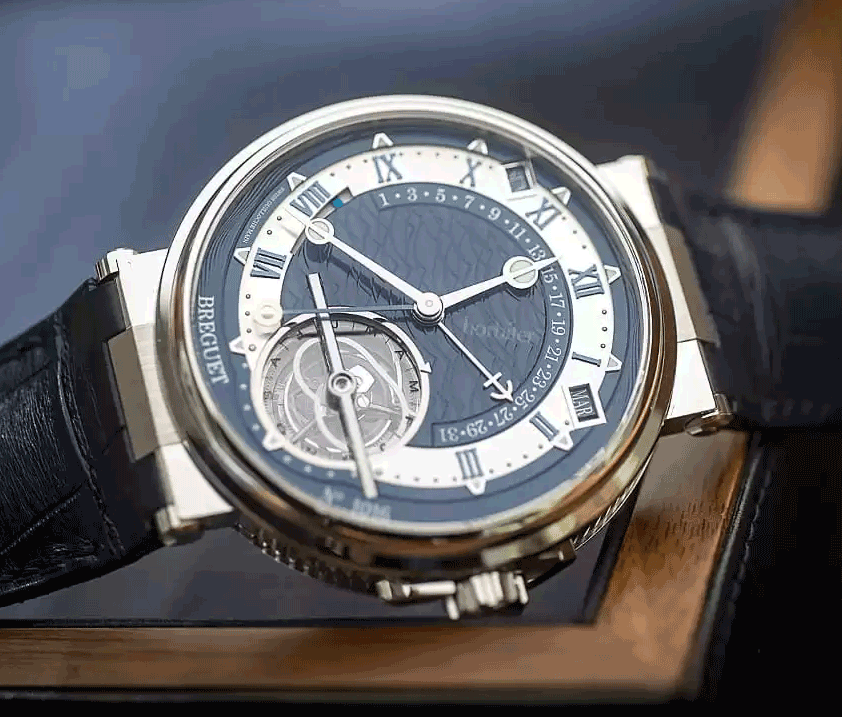
Beyond the escapement, Breguet uses the platform to reimagine the Marine. The 43.5mm by 13.3mm case in Breguet gold leans angular, with faceted triple lugs and blue ALD inlays. A modern riff on the classic coin-edge appears along the caseband. The openworked dial reveals the mechanics, while a regulator layout emphasizes chronometry. It is bold, coherent, and clearly more contemporary than past Marines.
The display does trade some legibility for drama, though lume on the chapter rings helps at night. Four mainsprings sit in two barrels, paired in parallel and separated by sapphire discs to cut friction. They deliver a 72-hour reserve despite the tourbillon and a 10 Hz beat. Water resistance reaches 100 meters, and the strap swaps quickly. However, a pin buckle feels conservative on such a sporty case. The tourbillon does not hack, which limits exact time setting, yet the overall execution is compelling in person.
Price, Rivals, and What Comes Next
The Expérimentale 1 costs CHF 320,000 and is limited to 75 pieces. In this arena, its rivals use other paths to steady power. Urban Jürgensen’s UJ-1 and Grand Seiko’s Kodo deploy constant-force solutions with traditional escapements. A. Lange & Söhne’s Richard Lange Tourbillon Pour le Mérite relies on a fusée-and-chain. None, however, uses a magnetic escapement in a tourbillon, which makes Breguet’s approach unique.