
Charles Sykes and the Soul of Rolls-Royce
Charles Robinson Sykes at Life in Classic
Marking 150 Years of a Visionary
Rolls-Royce Motor Cars is honoring the 150th anniversary of Charles Robinson Sykes, born on December 18, 1875. The celebrated artist and sculptor created the Spirit of Ecstasy, the emblem that has come to define the marque worldwide. His contribution reached beyond form. He brought emotion, elegance, and narrative to a company famed for engineering excellence.
Within the brand’s founding story, observers often describe Charles Rolls as the heart and Sir Henry Royce as the mind. In that telling, Sykes emerges as the soul. His art bridged mechanical mastery and human feeling. As a result, the Rolls-Royce identity grew to include grace and poise, not just precision and power.
Today, the company’s Bespoke and Coachbuild programs still draw on that artistic spirit. Moreover, Sykes’s influence appears in every modern interpretation of the mascot and in the way the brand speaks about motion, quiet, and presence.
From The Whisper to a Legend
The Spirit of Ecstasy began with a private commission. In 1909, motoring pioneer John Walter Montagu asked Sykes for a personal mascot for his Rolls-Royce Silver Ghost. Sykes modeled the figurine on Montagu’s secretary and confidante, Eleanor Velasco Thornton. He called the piece The Whisper. The figure held a finger to her lips, a discreet symbol for a quiet, concealed romance.
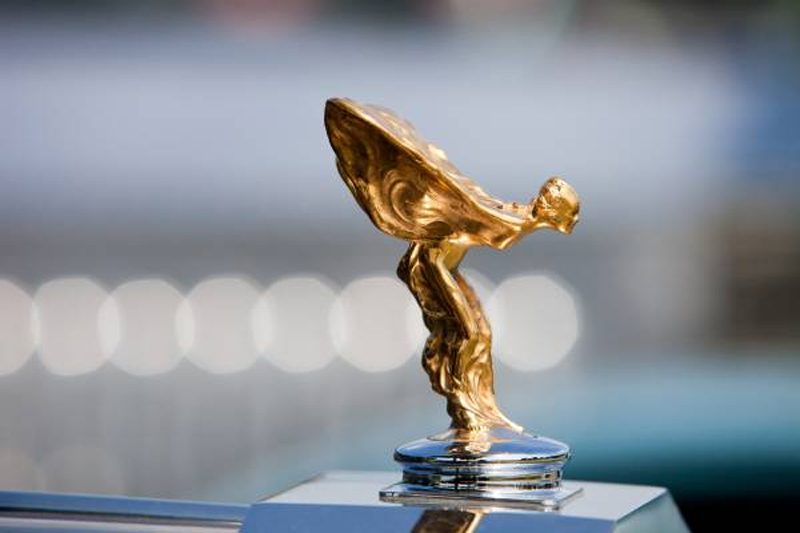
Two years later, the company sought an official emblem. Owners had started fitting mascots of varying taste, and Rolls-Royce wanted a dignified signature for the prow of its cars. Sykes adapted his earlier work into a new design. He captured what the company stood for at the time: speed with silence, effort without vibration, and energy under serene control.
On February 6, 1911, Rolls-Royce formally adopted the Spirit of Ecstasy. The small, winged figure expressed confidence, motion, and restraint. It also gave the brand a timeless face that felt poetic and modern all at once.
Craftsmanship, Uniqueness, and Family Stewardship
Sykes did far more than sculpt a single prototype. For years, he personally cast and finished Spirit of Ecstasy figurines. Because he supervised each step, no two pieces were exactly the same. Therefore, early mascots carry subtle differences in posture, drapery, and detailing.
From 1911 to 1928, Sykes oversaw production himself. Then his daughter, Josephine, continued the work with the Spirit of Ecstasy team until 1948. Her stewardship ensured continuity of standards and style. After that, Rolls-Royce brought production fully in-house, preserving the emblem’s quality while meeting growing demand.
This devotion to craft made the mascot more than a badge. It became an object of art, with the touch of a maker evident in every curve. Consequently, collectors and historians view these early pieces as artworks as much as automotive ornaments.
Artistry Beyond the Bonnet
Although the Spirit of Ecstasy achieved global fame, Sykes maintained a broad artistic career. He worked across media and subjects, and leading institutions collected his output. Notably, the Victoria and Albert Museum in London houses examples of his work.
His original The Whisper sculpture is on display at the National Motor Museum in Beaulieu. Visitors can trace the transition from private commission to public icon. In this journey, Sykes demonstrates how a small sculpture can carry complex ideas: discretion, speed, grace, and power held in balance.
The company once described the figure as a graceful goddess reveling in road travel, fresh air, and the music of her flowing drapery. That phrasing endures because it still fits the brand. It speaks to motion made effortless and luxury made sincere.
An Emblem for a New Era
Through the decades, the Spirit of Ecstasy remained central to Rolls-Royce design. It appears on modern models such as Phantom, Ghost, Cullinan, Dawn, and Wraith. It also graces classics like the Silver Shadow. In recent years, the figure has gained new treatments, including illuminated versions and lower profiles for improved aerodynamics.
In 2022, the marque introduced a more aerodynamic Spirit of Ecstasy for its electric Spectre. The revised stance reduces drag while preserving character. Therefore, Sykes’s original idea continues to guide the brand into electrification, where silence and smoothness matter even more.
Special projects also celebrate the emblem’s story. The Phantom Scintilla Private Collection, for instance, explores the mascot’s fleeting presence and dynamism. It even nods to the ancient winged sculpture that inspired Claude Johnson’s 1910 brief for a Rolls-Royce figurine.