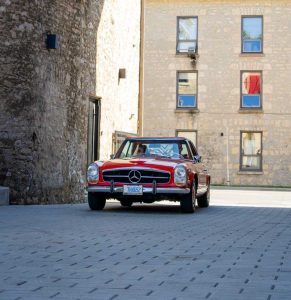

The Car That Proved Size Doesn’t Matter

Classic Mini at Life in Classic
In the late 1950s, the automotive world believed in one simple equation: bigger meant better. Bigger engines, longer bodies, wider roads, more chrome. Then a tiny British car arrived and quietly dismantled that logic.
The classic Mini did not just challenge the idea that size equaled importance — it proved the opposite. It showed that intelligence, efficiency, and character could outweigh displacement, prestige, and excess. More than sixty years later, its lesson still resonates far beyond the automotive world.
This is the story of how a small car changed everything.
Born from Necessity, Not Ego
The Mini was not conceived as a style statement or a prestige project. It was born from crisis.
After the Suez Canal crisis of 1956, fuel shortages hit Europe hard. British Motor Corporation needed a car that consumed less fuel, used fewer materials, and still transported four adults comfortably. The brief was brutally pragmatic: minimal size, maximal usefulness, minimal cost.
Enter Alec Issigonis.
Issigonis did not approach the problem by shrinking an existing car. He rethought the car entirely. The result was revolutionary: a transverse engine, front-wheel drive, wheels pushed to the very corners, and an interior that felt impossibly spacious for such a small footprint.
The Mini was not small by compromise. It was small by design.
Engineering That Served People, Not Numbers
What made the classic Mini extraordinary was not a single innovation, but how all its decisions served a clear purpose.
By rotating the engine sideways and integrating the gearbox into the oil sump, Issigonis freed up space. By using tiny wheels and short overhangs, he maximized cabin room. By prioritizing simplicity, he kept weight down and handling sharp.
The result was a car that felt alive.
Drivers did not talk about horsepower figures. They talked about how the Mini darted through corners, how it felt glued to the road, how it made everyday driving engaging. It delivered something rare even today: mechanical honesty.
The Mini proved that driving pleasure is not proportional to size or power. It is proportional to connection.
The Mini did not become a cultural icon through marketing strategy. It became one by being everywhere — and by fitting into everyone’s life.
It was affordable enough for young families, fashionable enough for artists, practical enough for city life. In 1960s Britain, the Mini became inseparable from the cultural energy of the time. It appeared in films, music, fashion photography, and city streets.
From Twiggy to The Beatles, from London to Monte Carlo, the Mini symbolized a new idea of modernity: smart, compact, confident.
Unlike luxury cars that signaled status, the Mini signaled attitude.
David vs Goliath: Motorsport Immortality
If the Mini had only been practical, it would already be important. But motorsport elevated it to legend.
When the Mini Cooper began winning rallies — most famously the Monte Carlo Rally — it shocked the establishment. Here was a tiny economy car humiliating larger, more powerful machines on the world stage.
Those victories were not flukes. They were proof of concept.
Light weight, superb traction, and exceptional handling allowed the Mini to exploit real-world conditions where brute force failed. It embodied a truth that racing often forgets: intelligence beats excess.
That underdog story still fuels the Mini’s mythology today.
Living With a Classic Mini Today

What is perhaps most remarkable is that the classic Mini still makes sense today — not as a museum piece, but as a lived experience.
Yes, it is noisy. Yes, it is basic. Yes, it requires patience and mechanical sympathy. But in return, it offers something modern cars struggle to deliver: clarity.
Every input matters. Every journey feels intentional. At modest speeds, the Mini feels engaging in a way many modern performance cars only achieve at illegal velocities.
Owning a classic Mini is not about nostalgia alone. It is about rediscovering why driving mattered in the first place.
Why the Mini’s Philosophy Matters More Than Ever
In an era of ever-larger vehicles, increasing complexity, and digital mediation, the Mini’s philosophy feels almost radical again.
Today’s cars are safer, faster, more comfortable — but often emotionally distant. The Mini reminds us that constraints breed creativity, that efficiency can be joyful, and that design should serve people before marketing narratives.
The Mini did not try to impress. It tried to work well.
And in doing so, it earned lasting admiration.
Size Was Never the Point
The classic Mini did not prove that small cars are better than big ones. It proved something more important: that size is irrelevant when intelligence leads the design.
It showed that greatness is not measured in dimensions, cylinders, or status — but in impact.
More than half a century later, the Mini’s influence can be seen in almost every compact car on the road. Its spirit lives on wherever simplicity, efficiency, and joy intersect.
The Mini proved that size doesn’t matter.
And the world has never been the same since.