
The Mercedes CLK-GTR and C112: When Mercedes Built a Monster for the Road

Mercedes CLK-GTR at Life in Classic
The Mercedes CLK-GTR and C112: When Mercedes Built a Monster for the Road
The Mercedes CLK-GTR C112 occupies a unique and uncomfortable place in automotive history. It is not simply a supercar, nor even a hypercar in the modern sense. Instead, it is a race car reluctantly adapted for the road, created to satisfy a rulebook rather than a market.
Built in extreme haste, produced in microscopic numbers, and designed with little concern for comfort, the Mercedes CLK-GTR C112 represents a rare moment when Mercedes-Benz chose dominance over diplomacy. The result was one of the most uncompromising road-legal cars ever constructed.
To understand how such a machine came to exist, it is necessary to begin with motorsport regulations.
GT1 Regulations and the Birth of the Mercedes CLK-GTR C112
In the mid-1990s, the FIA GT Championship introduced GT1 regulations requiring manufacturers to produce a small number of road-legal cars to homologate their racing entries. The intention was to preserve a connection to production vehicles.
Mercedes interpreted this requirement with ruthless clarity.
Rather than adapting an existing road car for competition, Mercedes, together with AMG and HWA, built a pure racing prototype first. Only afterwards did they engineer just enough road-going examples to satisfy homologation rules.
As a result, the Mercedes CLK-GTR C112 was conceived backwards. Racing priorities dictated everything, while road usability remained a secondary concern.
The Mercedes C112: The Concept That Led to the CLK-GTR
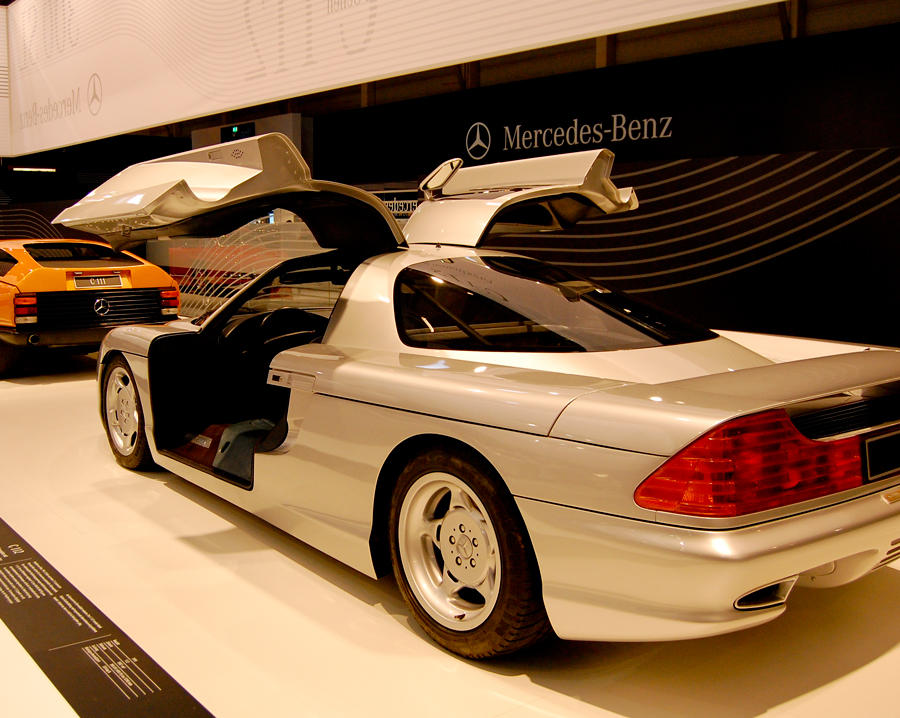
The philosophical roots of the CLK-GTR can be traced back to the Mercedes C112, unveiled as a concept in 1991. Although never approved for production, the C112 demonstrated that Mercedes was willing to explore extreme performance when freed from convention.
The C112 featured a carbon-fibre chassis, active aerodynamics, and a mid-mounted V12. More importantly, it introduced a mindset: Mercedes could build a no-compromise supercar if the strategic justification existed.
Several years later, GT1 regulations provided exactly that justification.
Built Backwards: Race Car First, Road Car Second
Development of the CLK-GTR progressed at an extraordinary pace. From concept to competition debut, the project moved in a matter of months rather than years.
Consequently, the road version retained almost all of the race car’s architecture. A carbon-fibre monocoque formed the backbone, complemented by pushrod suspension and racing-derived geometry. The driving position, visibility, and ergonomics were dictated by competition needs rather than comfort.
In effect, the Mercedes CLK-GTR C112 was not inspired by a race car. It was the race car.
The V12 Powertrain of the Mercedes CLK-GTR C112
Power came from a naturally aspirated 6.9-litre V12 producing approximately 612 horsepower and 775 Nm of torque. This engine was paired with a sequential manual gearbox derived directly from racing applications.
There was no automatic transmission option. Sound insulation was minimal. Mechanical noise dominated the cabin.
As a result, acceleration figures alone fail to capture the experience. The Mercedes CLK-GTR C112 demanded constant attention, rewarding precision while punishing hesitation.
Design Driven Entirely by Function
Despite carrying the CLK name, the CLK-GTR shared virtually nothing with the road-going Mercedes CLK. The resemblance existed purely for homologation optics.
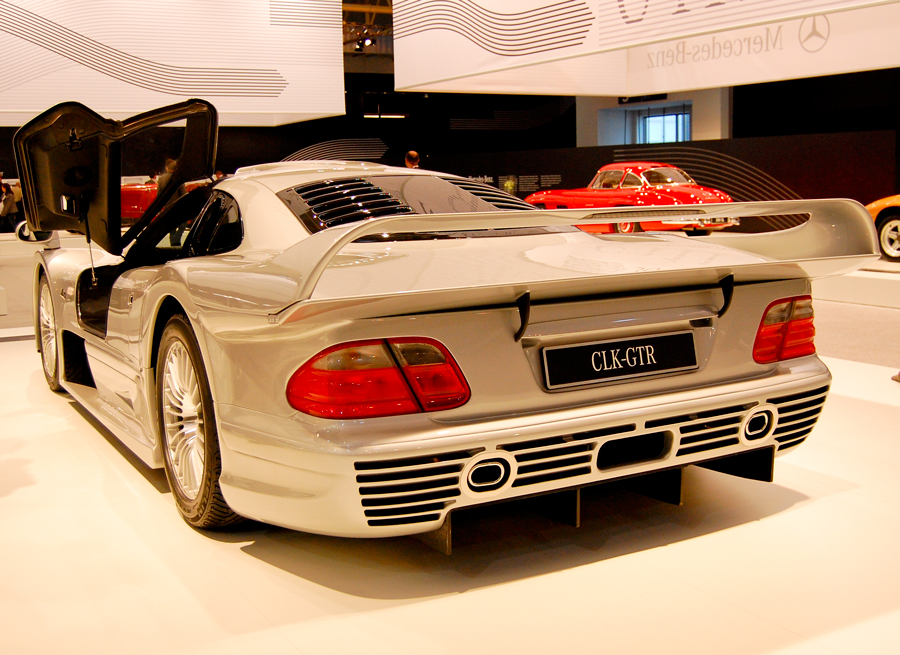
Aerodynamics dictated every surface. Large cooling openings, a pronounced rear wing, and an aggressive front splitter defined the car’s appearance. Elegance was irrelevant; effectiveness was paramount.
The design communicates speed even at rest, because nothing about it is decorative.
Interior: Minimalism Without Apology
Inside, the Mercedes CLK-GTR C112 offers a stark environment. Carbon fibre dominates the cabin, while racing seats and harnesses replace traditional luxury appointments.
Air conditioning was optional. Storage space was negligible. Visibility was compromised by the low seating position and wide bodywork.
Nevertheless, this austerity was intentional. Every gram saved improved performance, and every compromise avoided preserved the car’s purpose.
Mercedes CLK-GTR C112 Production Numbers and Rarity
Mercedes officially produced 25 road-going CLK-GTRs, including 20 coupés and 5 roadsters. Each example was hand-built and sold to a highly restricted group of buyers.
From the outset, rarity was guaranteed. Over time, scarcity transformed the Mercedes CLK-GTR C112 into one of the most valuable homologation cars of the modern era.
Motorsport Success That Justified the Extremes
The racing version of the CLK-GTR achieved immediate success. During the 1997 FIA GT Championship, Mercedes dominated the season, securing the manufacturers’ title with consistency and authority.
According to official FIA GT Championship records, the CLK-GTR’s performance validated the radical approach. Without these victories, the project might have been remembered as excess. With them, it became legend.
Why the Mercedes CLK-GTR C112 Could Not Exist Today
Modern regulations, emissions standards, and corporate risk management make cars like the CLK-GTR nearly impossible to justify today. Manufacturers now prioritise adaptability, compliance, and scalability.
The Mercedes CLK-GTR C112 belongs to a brief window when regulations allowed audacity. Once that window closed, so did the era of true homologation monsters.
Cultural Status Built on Respect, Not Romance
Unlike many classic cars, the CLK-GTR does not rely on nostalgia. It commands respect rather than affection.
Collectors admire it for its clarity of intent. There is no lifestyle narrative, no attempt at emotional marketing. Instead, the car represents a moment of absolute focus.
This places it alongside other homologation legends discussed in How the Mini Conquered Monte Carlo (internal link).
The Legacy of the Mercedes C112 and CLK-GTR
Together, the C112 and the Mercedes CLK-GTR C112 represent ambition without dilution. There is no direct successor and no modern equivalent.
Cars such as the Porsche 911 GT1 and McLaren F1 GTR share this lineage, forming the final chapter of an uncompromising era, much like the philosophy explored in The Car That Proved Size Doesn’t Matter (internal link).
More Than a Supercar
The Mercedes CLK-GTR C112 matters not because it is fast, rare, or expensive, but because it exposes a deeper truth about engineering culture.
When constraints loosen and winning becomes the only objective, creativity becomes dangerous — and extraordinary.
The Mercedes CLK-GTR C112 was never meant to be loved. It was meant to win.
That it achieved both is what secures its place in history.