
Rediscovering Patek Philippe’s First Perpetual Calendar
Patek Philippe’s Reference 1526 At Life in Classic
A Milestone That Quietly Changed Watchmaking
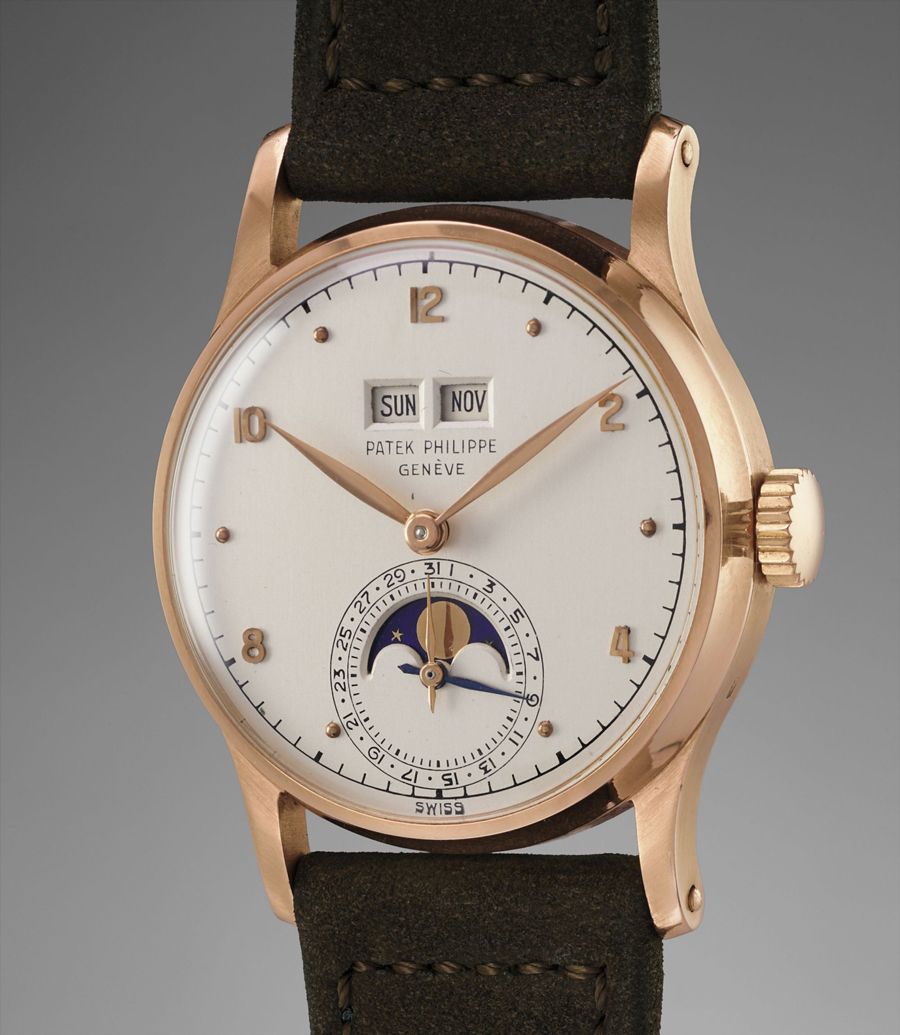
Launched in 1941 and produced through 1952, Patek Philippe’s Reference 1526 was the first serially produced perpetual calendar wristwatch. Although it lived in the shadow of its famous sibling, the chronograph-equipped 1518, the 1526 set the blueprint many brands still follow. Its signature layout—day and month windows at the top with a lower sub-dial combining date, small seconds, and moonphase—became a design language all its own.
Production remained small. Research suggests only 210 examples left the manufacture: 165 in yellow gold, 45 in pink gold, and one known special order in steel by George Croisier. In period, it retailed for $1,200, while the 1518 cost $1,500. Yet the 1526’s cultural reach was notable. Clark Gable wore one on screen in 1955. Eric Clapton owned a documented example. Most recently, technology leaders have been seen with the reference in high-profile settings. As collectors revisit mid-century Patek, the 1526 increasingly reads as an undervalued cornerstone.
Three Series That Shaped the Blueprint
Across its run, the 1526 evolved in three distinct series. The First Series (1941–1942) appears to total only seven known examples. Early dials featured large Arabic numerals and, on some, Breguet hands. The initial sub-dial used railroad tracks for both date and seconds, with the date inside and seconds outside. Cases measured close to 35 mm with pronounced “claw” lugs and a concave, broad bezel. Calendar windows were straight-cut with gentle bevels and a wide divider.
The Second Series (1943–1947) standardized the diameter to 34 mm. Arabic numerals became smaller, and the sub-dial gradually simplified. It lost the lower railroad, then used numerals at ten-second intervals, and later only hash marks. Calendar window bevels remained modest, with a wide central divider. Hallmarks typically sat under a lug and on the case flank.
The Third Series (1948–1952) introduced the short “Patek Philippe” signature, sharper window bevels, and a thinner divider between the apertures. The bezel profile became slightly less concave, while lugs looked a touch less clawed. Late examples sometimes showed a rare, cleaner sub-dial with date-only markings. As a result, the watch’s face grew calmer and closer to the future center-seconds 2497.
Dial, Windows, and the Moonphase
The 1526 dial reflects an artisanal era. Stern Frères produced gold dial blanks that were silvered and given a soft opaline finish. Tracks and signatures were engraved and filled with enamel, not merely printed. Most pieces alternated small Arabic numerals and applied gold dots for the hours. Moreover, many dials received a protective layer of zapon lacquer, which often yellowed with time and now signals originality.
Collectors value dials that retain crisp engraving, correct signatures for their year, and matching movement numbers stealthily scribed on the back. Date discs for day and month were also 18K gold, hand-stenciled, engraved, and enameled. Over time, the calendar windows evolved from flat cut-outs to deeper, more defined bevels, particularly after the switch to the short signature in 1948. Meanwhile, the moonphase disc stands out as miniature sculpture: a 22K gold base, polished moons and stars, and rich blue champlevé enamel. It advances via a 59-tooth ring to recreate the 29.5-day lunar cycle with satisfying precision.
Casework and the 12-120 QP Movement
All gold cases came from Vichet. The design follows the Calatrava line: a clean three-piece case with snap-on back and bezel. Correctors are discreetly set—month near 12 o’clock, day near 9 o’clock, and moonphase near 7 o’clock—preserving the purity of the profile. Over-polishing can erase the original lug symmetry and hallmark depth, so sharp, even lug shapes are a key buying signal.
Inside, the hand-finished caliber 12-120 served as the base for the 12-120 QP, a Piguet perpetual calendar module mounted under the dial. Geneva stripes, anglage, and the fine regulator show Patek’s finishing standards.